Asphalt Paving Kansas City — Full-Service Commercial Contractor
Kansas City's Trusted Asphalt Paving Contractor — One Crew, Every Paving Need
We install it, maintain it, and keep it compliant. Kansas City's full-service asphalt paving company — new asphalt paving, resurfacing, sealcoating, striping, and concrete construction handled by one paving contractor so you don't juggle five subcontractors.
Get a Free Estimate
Fill out this quick form and we'll get back to you within 24 hours.
Full-Service Asphalt Paving and Concrete Services in Kansas City
From new asphalt paving and construction to ongoing pavement maintenance, our Kansas City paving company handles every parking lot service in-house. No subcontractors, no runaround, no finger-pointing between trades. Below is exactly what we do, how we do it, and what you should know before you hire any asphalt paving contractor in the metro.
New Asphalt Paving
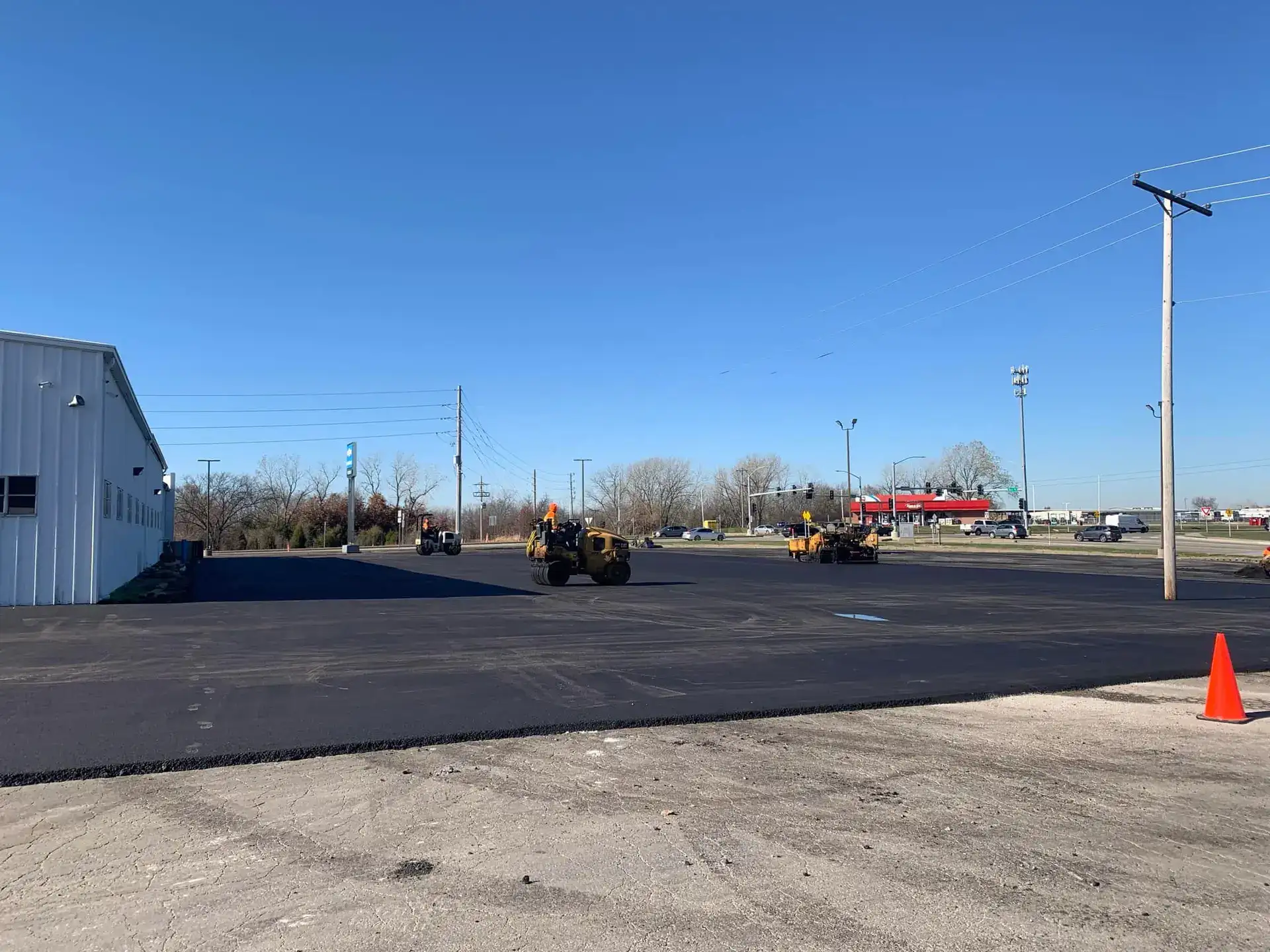
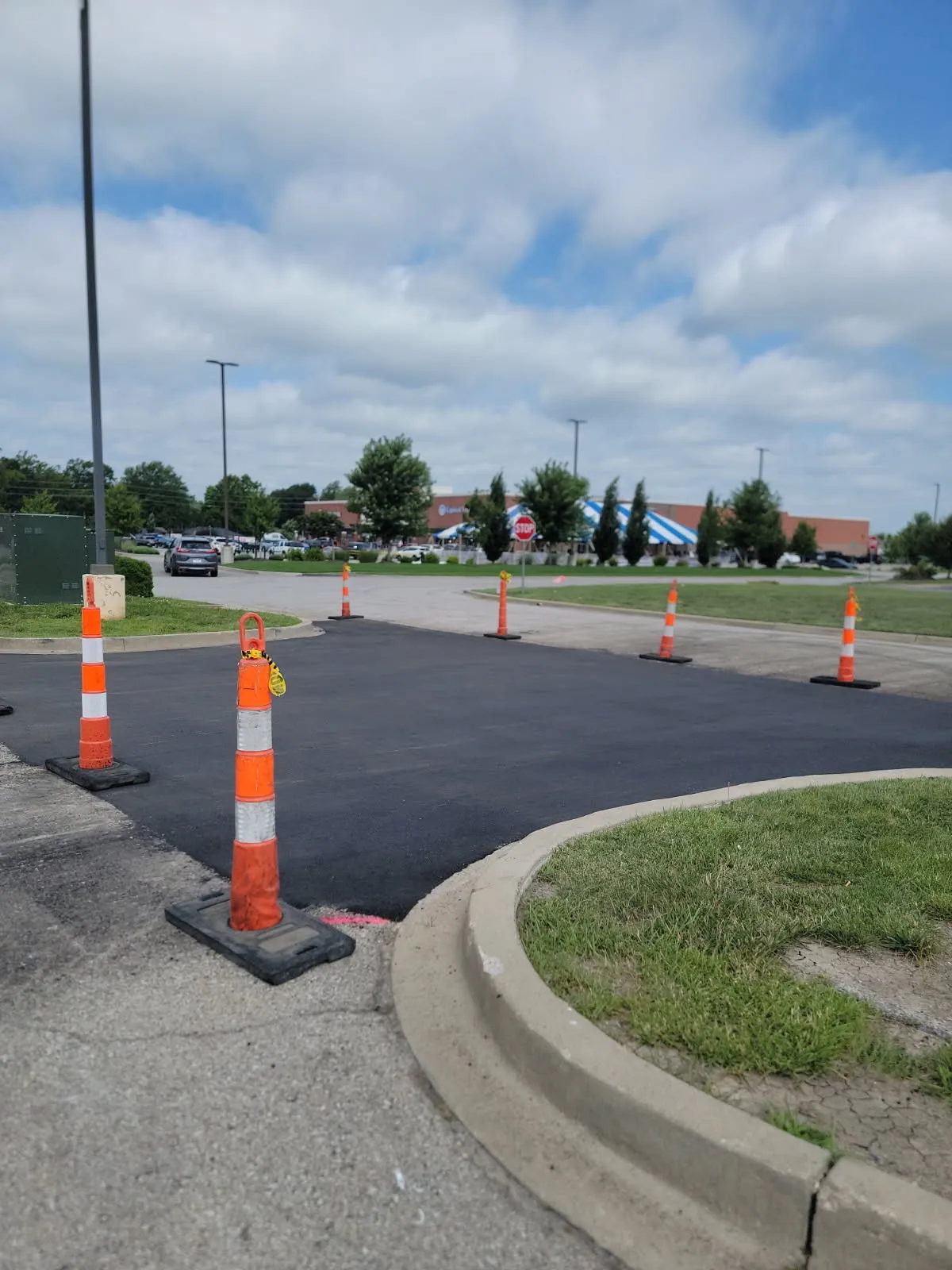
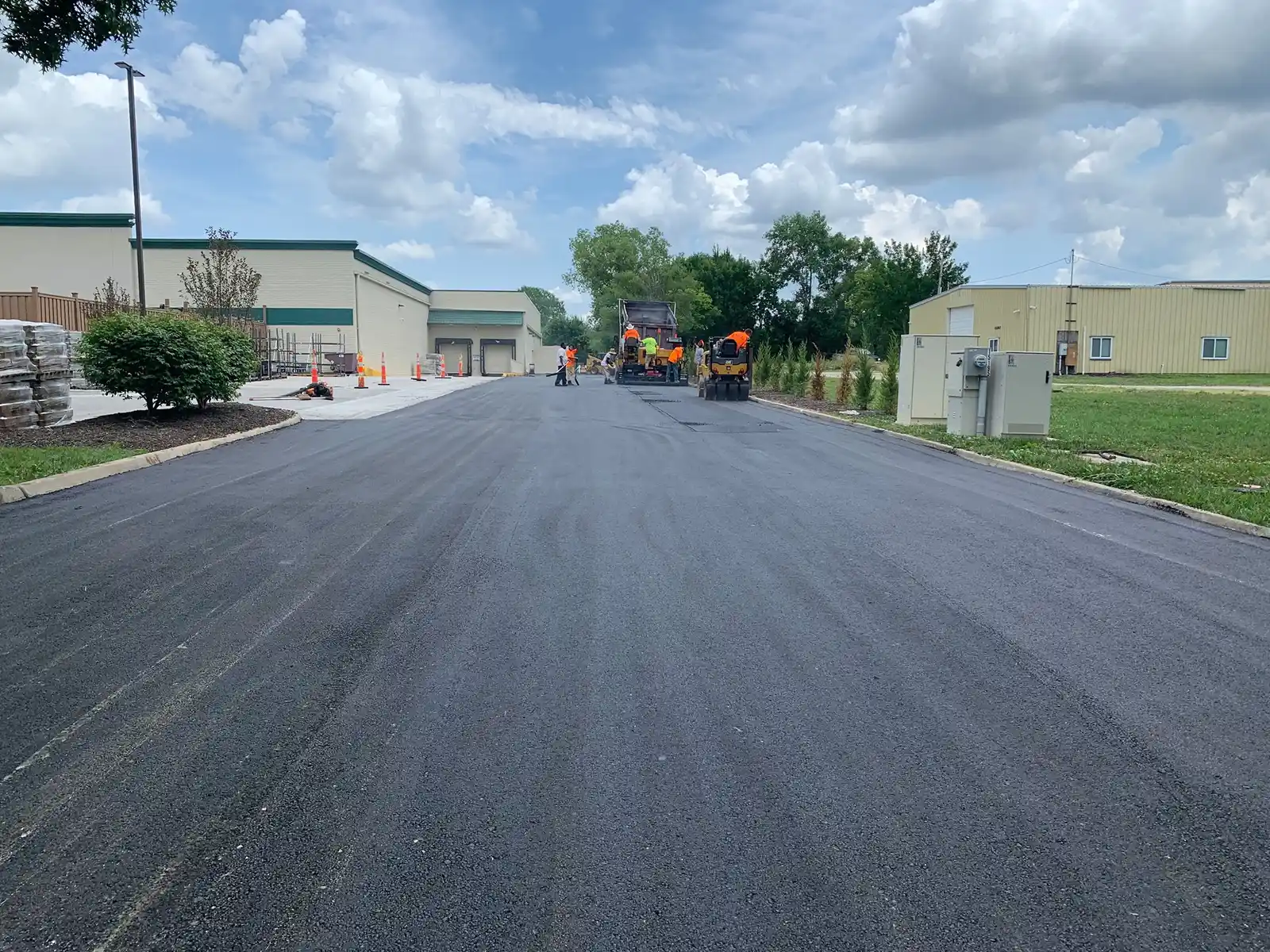
New asphalt paving — sometimes still called blacktop paving by long-time KC property owners — is full-depth hot-mix asphalt (HMA) installation built from the subgrade up. We pave commercial parking lots, industrial access roads, truck yards, and municipal projects across the Kansas City metro. Every new lot starts with proof-rolling the subgrade, placing a compacted aggregate base (typically 6–8 inches of crushed limestone for commercial lots), then laying a binder course and surface course of hot-mix asphalt at 275–300°F.
For a standard parking lot we install 2–3 inches of compacted asphalt over base. For heavy-truck zones, dock approaches, and trash compactor pads we step up to 4–6 inches with a stiffer binder. Compaction is verified with a nuclear density gauge — 92–96% Marshall density — so the surface won't ravel or rut after the first KC summer.
- Full-depth hot-mix asphalt installation, parking lots through industrial
- 2–3" residential/commercial mat, 4–6" for heavy-load areas
- Crushed-limestone base, proof-rolled and compacted before paving
- Nuclear density gauge compaction verification on every pour
Asphalt Overlays and Resurfacing
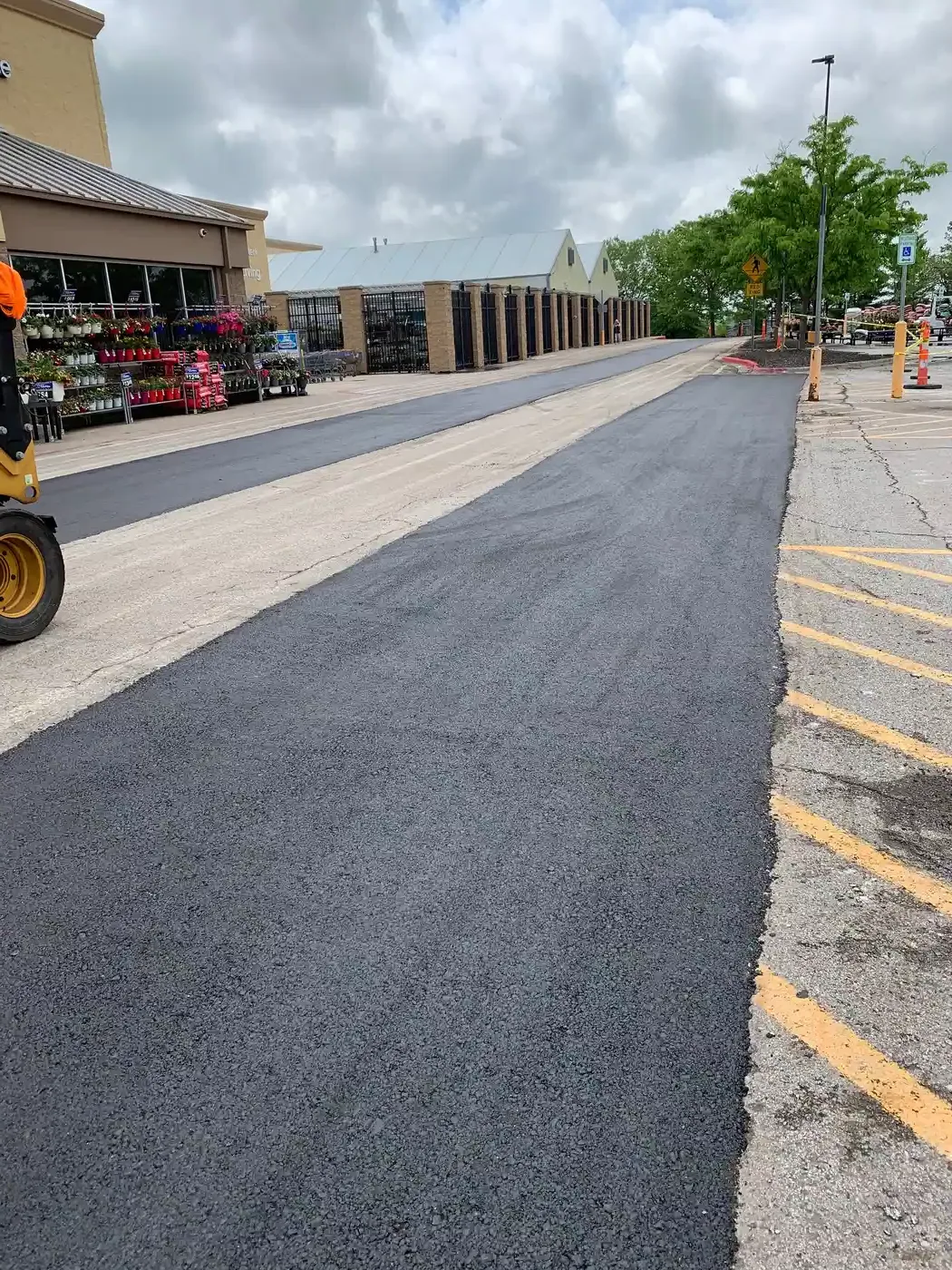
Asphalt resurfacing — also called an overlay — is the right call when your existing parking lot is showing surface cracking and oxidation but the underlying base is still structurally sound. Instead of demolishing and rebuilding the lot from scratch (and paying for it), we mill the failing surface course, apply a tack coat, and lay 1.5–2 inches of fresh hot-mix asphalt directly over the existing structure.
A direct overlay works when the base is intact and there's no significant alligator cracking. If the failure has reached the base, a mill-and-overlay is the right move — we cold-plane the top 1.5–2 inches off, repair any soft spots in the base, then resurface. We assess every overlay candidate in person before quoting, because there's no faster way to waste money than overlaying a lot that needed full reconstruction.
- 1.5–2" overlay thickness for commercial parking lots
- Mill-and-overlay when the surface course has fully failed
- Tack coat between old and new asphalt for proper bond
- On-site assessment to confirm overlay is the right call (not a sales upsell)
Asphalt Milling and Cold Planing
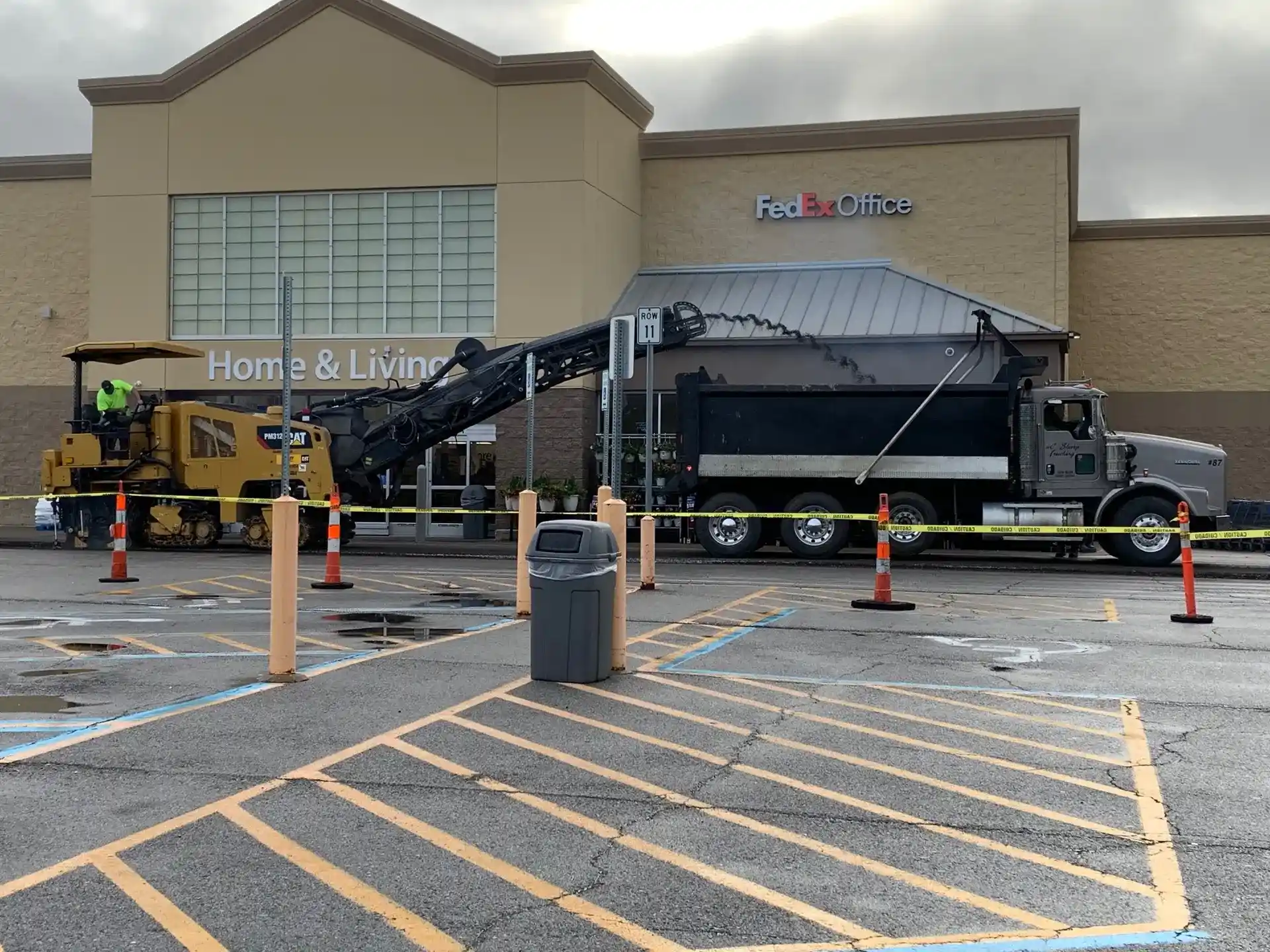
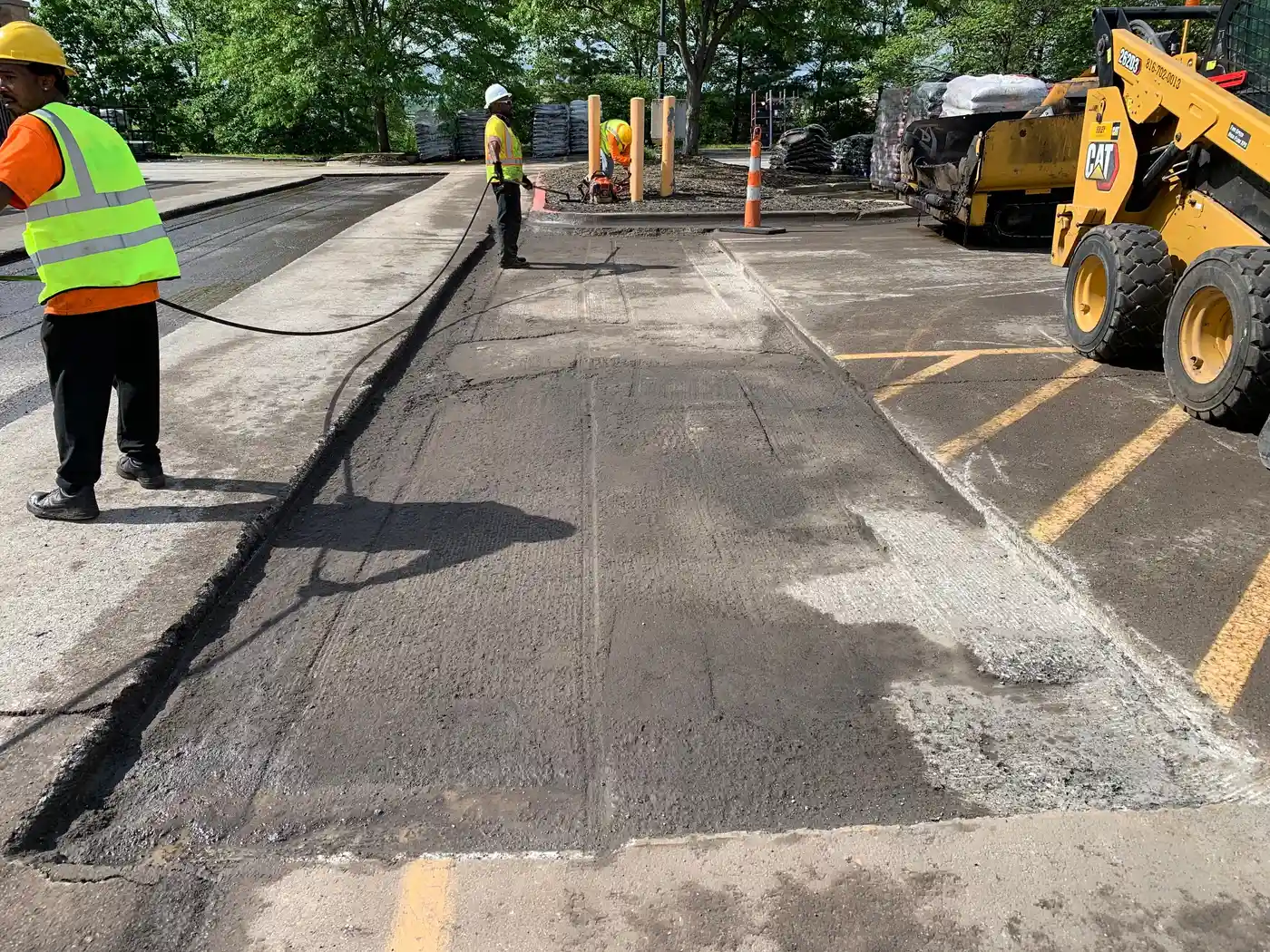
Asphalt milling — also called cold planing — is the controlled removal of the existing asphalt surface, usually to a depth of 1.5 to 4 inches. Milling is the prep step before any serious overlay or full reconstruction, and it's also how we handle elevation matching where new asphalt has to tie into existing curbs, drainage inlets, or building thresholds.
We mill with cold planers that produce a textured, broom-finished profile — exactly what a fresh overlay needs to bond. The reclaimed asphalt pavement (RAP) we generate is recycled into base material and new mix designs, which keeps cost down and waste out of the landfill. For tie-in work around manholes, valve boxes, and ADA ramps, we use small skid-steer-mounted milling heads to keep the profile clean.
- 1.5–4" milling depths for overlay prep and tie-in work
- Broom-finished surface profile for proper overlay bond
- RAP recycled into base material — sustainable and cost-effective
- Skid-steer milling for tight spots, manholes, ADA ramps
Asphalt Repair and Patching
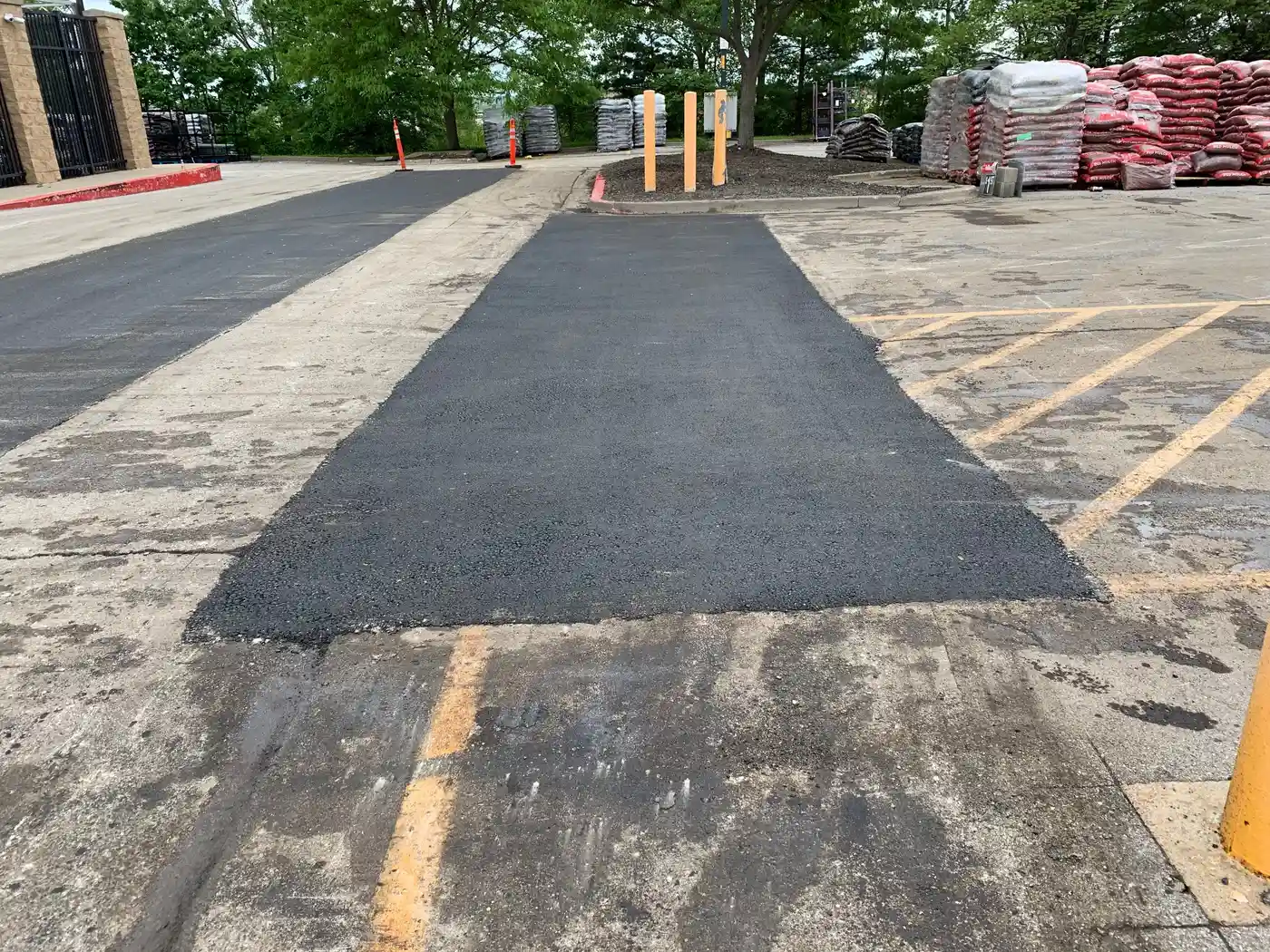
We do three kinds of asphalt repair, and the difference matters. Saw-cut patching is the permanent fix for failed sections — we square-cut the perimeter, excavate the failure to a clean edge, replace any compromised base, then install full-depth hot mix and compact it flush with the surrounding surface. Infrared patching reheats the existing asphalt, blends new material into the old, and produces a flush, bonded joint with no cold edge — best for shallow failures and isolated potholes.
Skin patching (also called overlay patching) is the lowest-cost option and the most often misused. It's appropriate for surface scaling and shallow distress only — not structural failure. We'll tell you when skin patching is the right call and when it's just a temporary that's going to fail again next freeze-thaw cycle.
- Saw-cut full-depth patching for permanent structural repairs
- Infrared patching for flush, bonded joints on isolated failures
- Skin patching only when it's actually appropriate
- Honest assessment of repair vs. overlay vs. reconstruction
Crack Sealing
Crack sealing is the single best dollar-for-dollar investment in pavement preservation. Cracks are how water gets into the base. Once water reaches the subgrade, the next freeze-thaw cycle pushes the crack wider, breaks the surrounding asphalt, and turns a $5 crack into a $500 pothole. We seal cracks with hot-pour rubberized sealant — applied at 380°F and self-leveling — that flexes with seasonal expansion and stays bonded through KC's freeze-thaw cycles.
For wider cracks (over 1/4 inch) we route the crack first to create a clean reservoir, blow out debris with high-pressure air, then apply the hot-pour sealant. For tight cracks we clean-and-seal with the same material. Crack sealing is most effective in the early stages — once the lot has progressed to alligator cracking and base failure, sealing won't bring it back.
- Hot-pour rubberized sealant applied at 380°F
- Routing for wider cracks, clean-and-seal for hairlines
- Best preservation tool while the lot is still salvageable
- Honest call on when it's too late to seal and time to overlay
Commercial Sealcoating
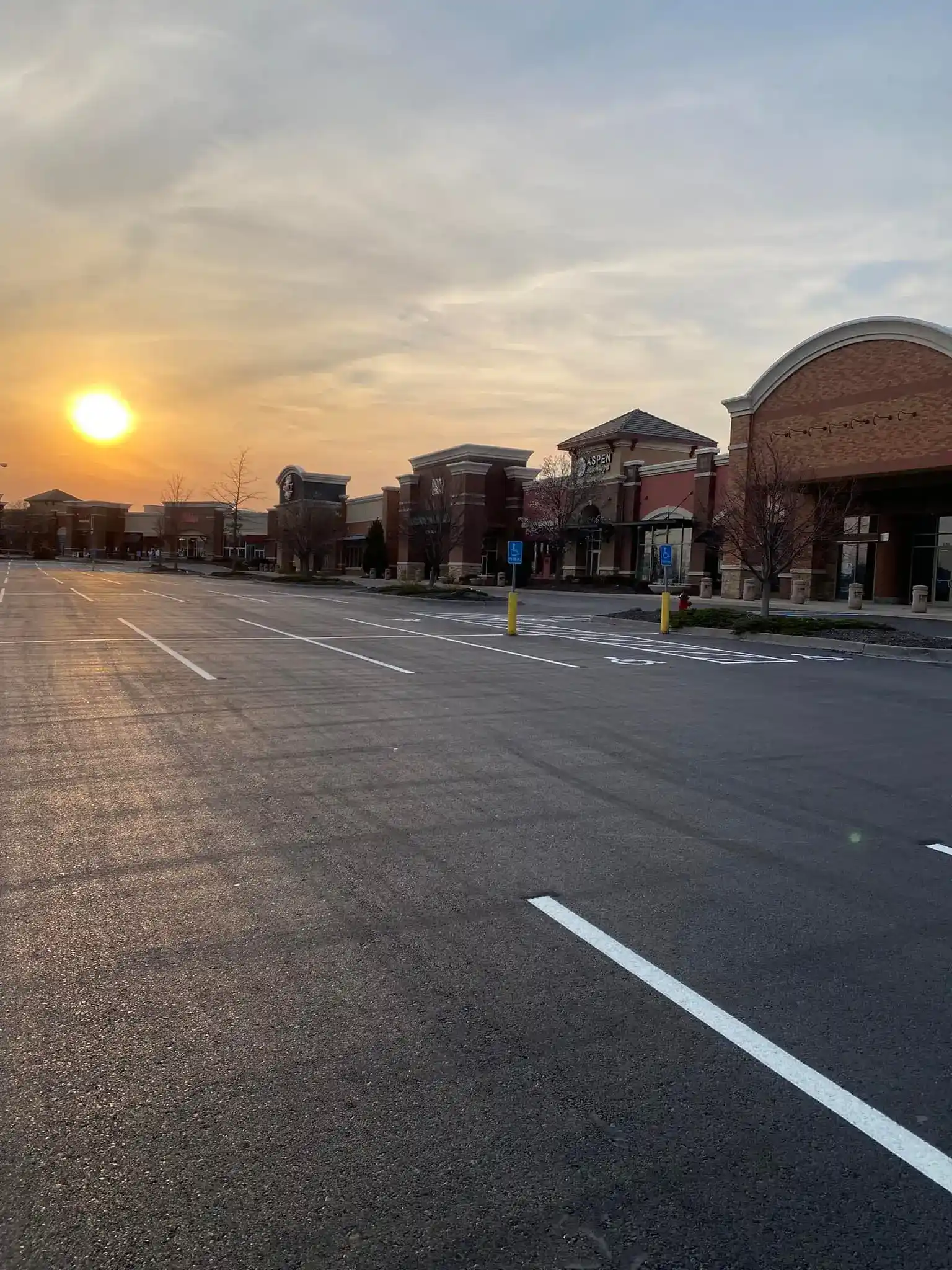
Commercial sealcoating is the protective coat that keeps UV oxidation, fuel spills, and water from breaking down your asphalt binder. We use both coal tar emulsion and asphalt emulsion sealcoats depending on the application, surface condition, and customer specification. Coal tar offers stronger fuel resistance and longer service life; asphalt emulsion is the lower-VOC alternative for properties with environmental sensitivity.
We apply sealcoat in two coats — squeegee for the first coat to fill surface texture and force material into hairline cracks, then a spray coat over the top for uniform coverage. Cure time is 24–48 hours before traffic. For most commercial properties we recommend recoating every 2–3 years; high-traffic retail and convenience-store lots may need it every 18–24 months. Sealcoat is preventive maintenance, not a repair tool — it won't hide cracks or fix base failure.
- Coal tar emulsion or asphalt emulsion (you choose)
- Two-coat application: squeegee first, spray finish
- 24–48 hour cure window before traffic returns
- 2–3 year recoat cycle for typical commercial properties
Line Striping and Pavement Marking
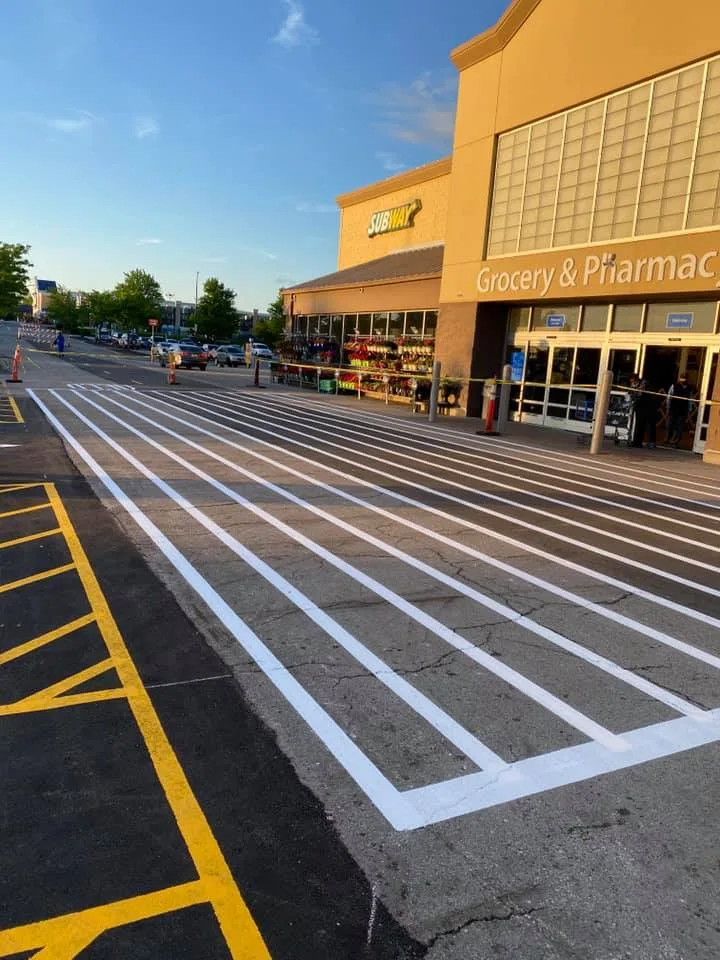
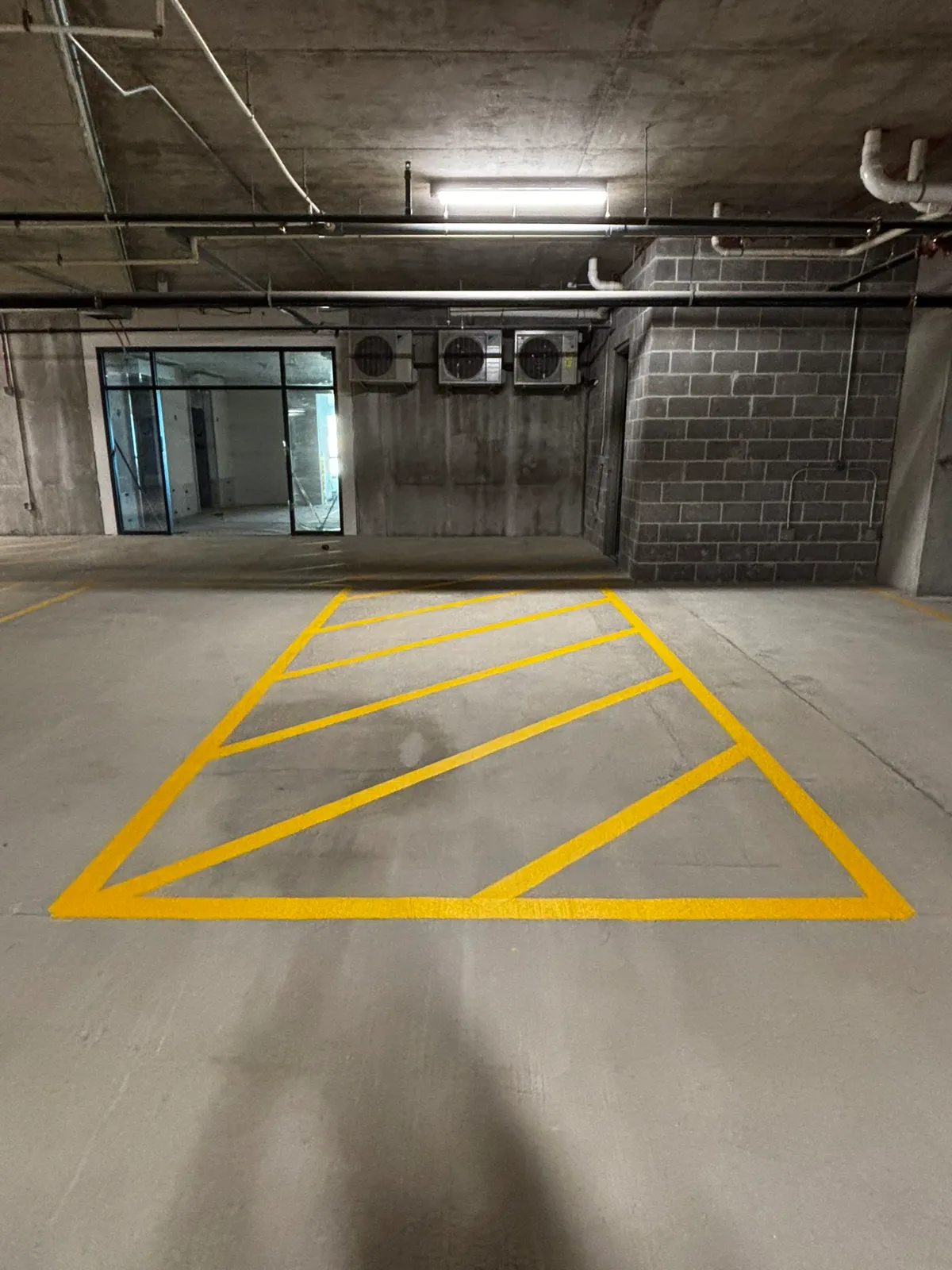
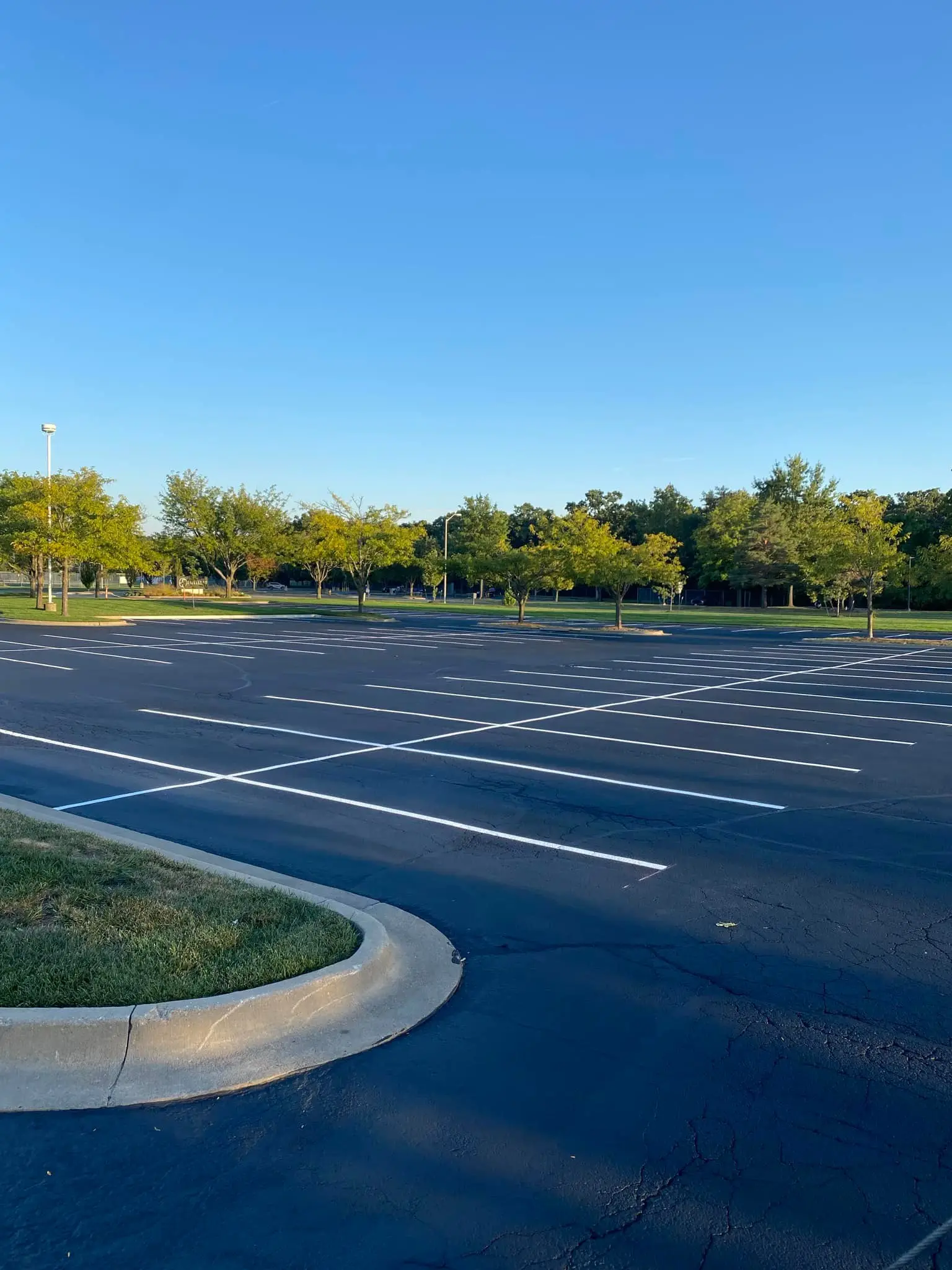
Line striping isn't just paint and a stencil. Stall layout drives the entire experience of a parking lot — circulation, ADA compliance, fire lane access, drive-through queueing. We layout, mark out, and stripe parking lots from scratch or restripe existing layouts. Standard work uses high-build traffic paint with reflective glass beads for nighttime visibility. For high-traffic crosswalks, fire lanes, and stop bars we install thermoplastic — a hot-applied marking that lasts 5–7 years versus 2–3 for paint.
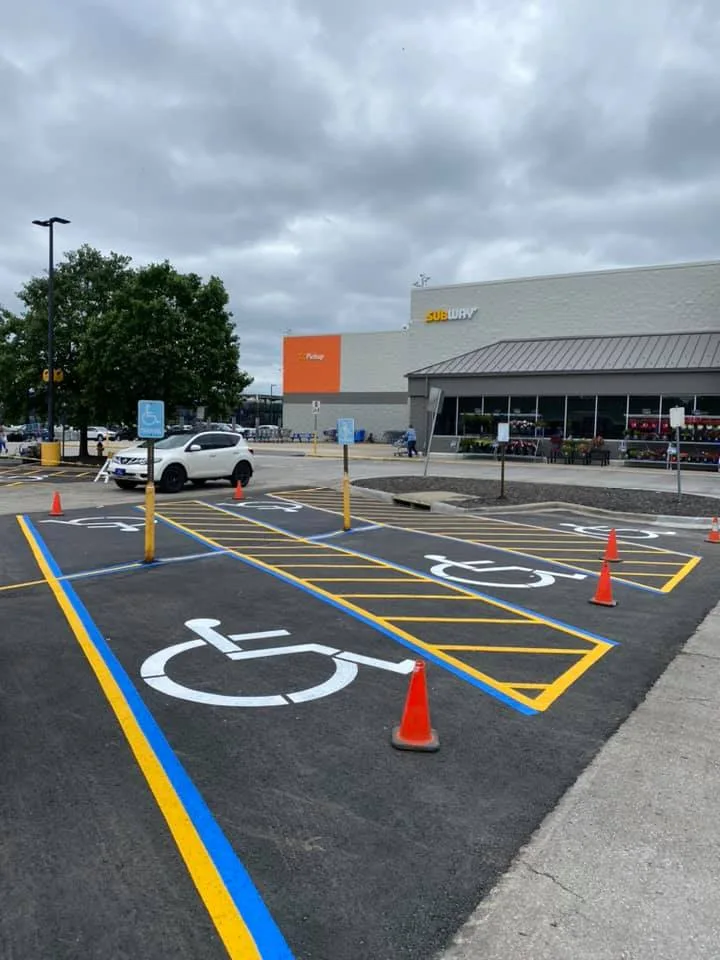
ADA compliance is built into every layout: 96-inch-wide accessible spaces with 60-inch access aisles, 96-inch van spaces with 96-inch access aisles, blue diamond pavement symbols, and properly mounted R7-8 signage. We re-stripe most commercial lots every 2–3 years to maintain visibility and code compliance.
- Reflective traffic paint or thermoplastic (you pick the lifespan)
- ADA-compliant accessible space layouts and signage
- Fire lanes, crosswalks, stop bars, directional arrows, stencils
- Layout services for new lots or re-layouts on resurfaced lots
ADA Ramps, Signage and Compliance
ADA compliance isn't optional, and the standards are specific. Accessible routes need a maximum running slope of 1:20 (5%) and a maximum cross slope of 1:48 (2.08%). Curb ramps cap out at 1:12 (8.33%) running slope with 60-inch minimum clear width. Accessible parking spaces are 96 inches wide (van accessible 132 inches), with 60-inch access aisles (96-inch for van). Truncated dome detectable warnings are required at every flush curb-to-street transition.
We bring lots up to current ADA standards: truncated dome panels, slope correction at curb cuts, blue diamond pavement symbols, R7-8 accessible parking signs at the proper 60-inch mounting height, and crosswalks connecting accessible spaces to building entries. Most existing lots that haven't been touched in 10+ years fail at least three of these standards. We'll tell you exactly what's out of spec and what it takes to fix.
- 1:12 max ramp slope, 60" minimum clear width
- 96" / 132" accessible and van-accessible space sizing
- Truncated dome panels at every flush transition
- R7-8 signage at 60" mounting height per current ADA
New Concrete Paving
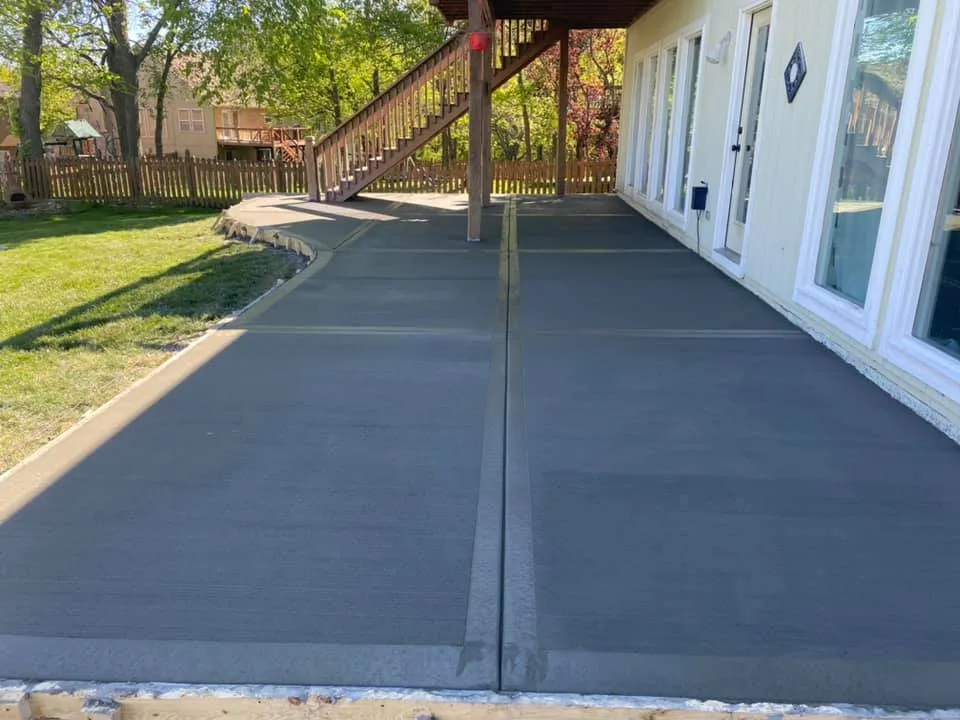
We pour concrete flatwork for the same commercial properties we pave with asphalt — sidewalks, dumpster pads, ADA ramps, approaches, dock aprons, and full concrete parking areas where the loading demands it. Standard mix design is 4,000 PSI Portland cement concrete with #4 rebar at 18-inch centers for structural slabs, or fiber-mesh reinforcement for sidewalks and lighter-duty flatwork.
Pour conditions matter. We don't pour below 40°F ambient or above 90°F without retarders, and we always cure with a curing compound or wet burlap to prevent surface checking. Control joints are sawed within 6–12 hours of finish — late enough to not ravel, early enough to stop random cracking. We broom-finish for traction or trowel-finish for interior approaches as the application requires.
- 4,000 PSI Portland cement concrete standard mix
- Rebar for structural slabs, fiber mesh for flatwork
- Sawed control joints within the proper window
- Cured properly so the surface doesn't check or scale
Concrete Repair
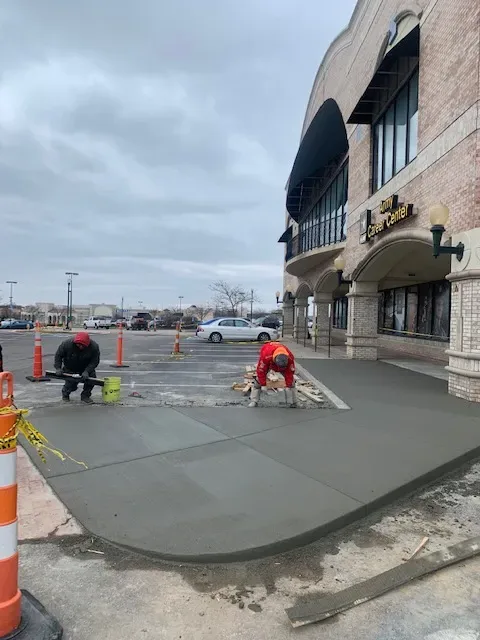
Concrete repair covers everything from settled sidewalk panels to spalled approach slabs to failing expansion joints. For settled panels we mudjack — pumping a slurry under the slab to lift it back to grade for a fraction of the cost of replacement. For spalled or cracked panels past saving, we saw-cut, demo, and replace the panel with new concrete, doweling into the adjacent slab to maintain load transfer.
Expansion and control joint repair is its own discipline — old joint material gets routed out, the joint is cleaned, backer rod is installed, and a new flexible sealant is applied. Skipping joint repair is one of the fastest ways to let water destroy a concrete surface from the inside out.
- Mudjacking for settled panels (cheaper than replacement)
- Saw-cut and replace for spalled or cracked panels
- Doweling for proper load transfer between old and new
- Expansion joint resealing — backer rod and flexible sealant
Curbs and Gutters
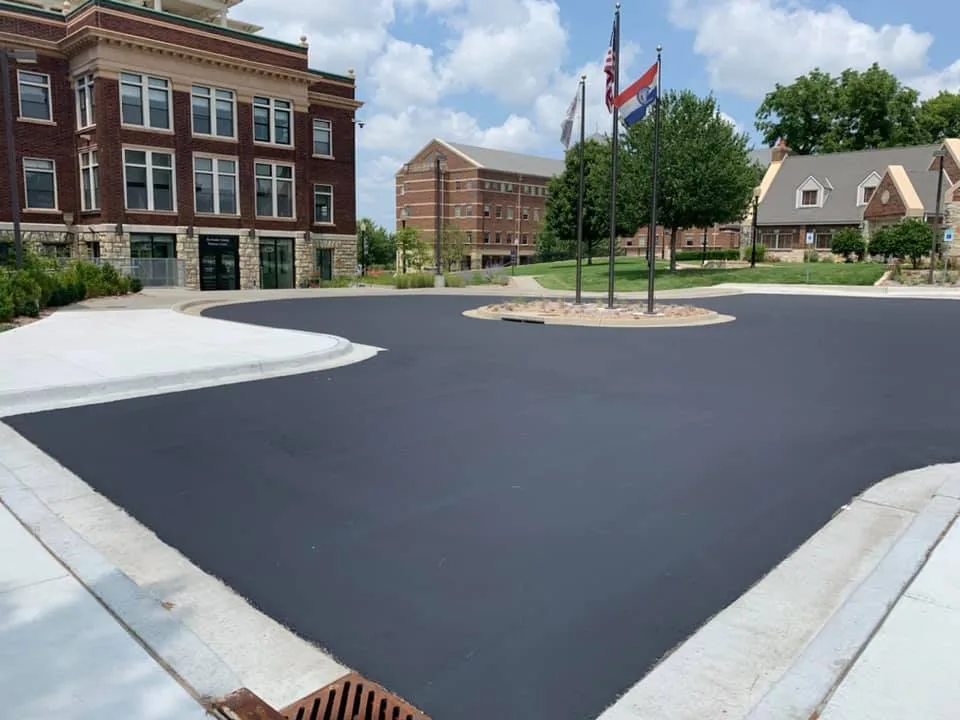
Curbs and gutters do two jobs: they define the edge of the lot for traffic control, and they channel stormwater to drainage inlets so the parking surface doesn't pond. We install both extruded curb (machine-poured in continuous runs, fast and economical for long straight runs) and formed curb (hand-built around radii, drainage inlets, and irregular geometry).
Standard commercial spec is 6-inch barrier curb with an integral 18-inch gutter pan for parking lots, or 4-inch rollover curb for landscape edges and median islands. We tie every curb run into the drainage system so water actually gets where it's supposed to go — a curb without grade is just a tripping hazard.
- Extruded curb for long straight runs
- Formed curb for radii, inlets, and irregular geometry
- Barrier curb, rollover curb, integral gutter pan
- Drainage tie-in so the curbs actually move water
Pothole Repair
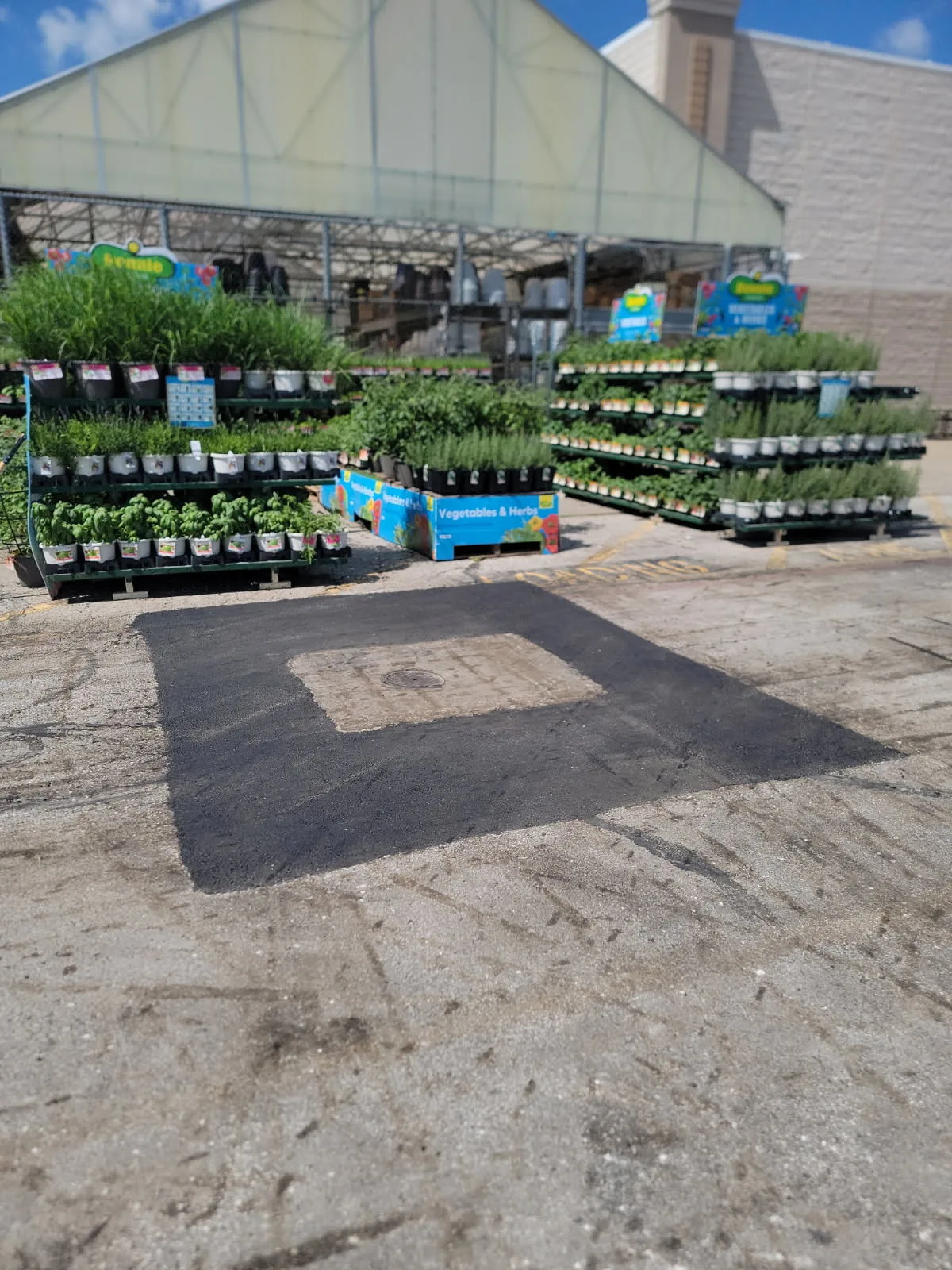
There's a right way and a wrong way to repair a pothole. The wrong way — what most contractors do, and what every property manager has had to call back about — is "throw-and-roll" with cold patch material: shovel it in, drive over it, hope it sticks. Cold patch is a temporary, period. It fails the first heavy rain or first freeze cycle.
The right way is a permanent hot-mix repair: square-cut the perimeter to a clean edge, remove all loose material down to sound base, blow out debris, apply a tack coat to the cut faces, fill with hot-mix asphalt in 2-inch lifts, and compact each lift with a vibratory plate or small roller until the patch is flush with the surrounding surface and the joint is sealed. That's how a pothole repair lasts. That's all we do.
- Permanent hot-mix repair, not throw-and-roll cold patch
- Square saw-cut perimeter, removed to sound base
- Tack coat applied to the cut faces for proper bond
- Lift-and-compact placement, joint sealed flush
Why Kansas City Property Managers Call Platinum Paving
Most asphalt contractors do one thing. Our paving company does everything — and we do it better.
| Platinum Paving | Typical Contractors | |
|---|---|---|
| Full-service (pave, seal, stripe, concrete) | One crew, one call | 3–5 different vendors |
| In-house crews | Our own trained team | Outsourced subcontractors |
| 1-year warranty on all work | Every project, every service | Varies or none |
| Owner-backed quality | Joe inspects every job | You deal with a project manager |
| ADA compliance included | Built into every lot project | Often an afterthought or upcharge |
| Kansas & Missouri coverage | 50+ KC metro communities | Limited service area |
| Commercial + residential | Parking lots to driveways | Usually one or the other |
Full-service (pave, seal, stripe, concrete)
In-house crews
1-year warranty on all work
Owner-backed quality
ADA compliance included
Kansas & Missouri coverage
Commercial + residential
Common Parking Lot Problems — and the Fixes
Click a hotspot to see the problem — and the fix. Every issue below is something we handle in-house, start to finish.
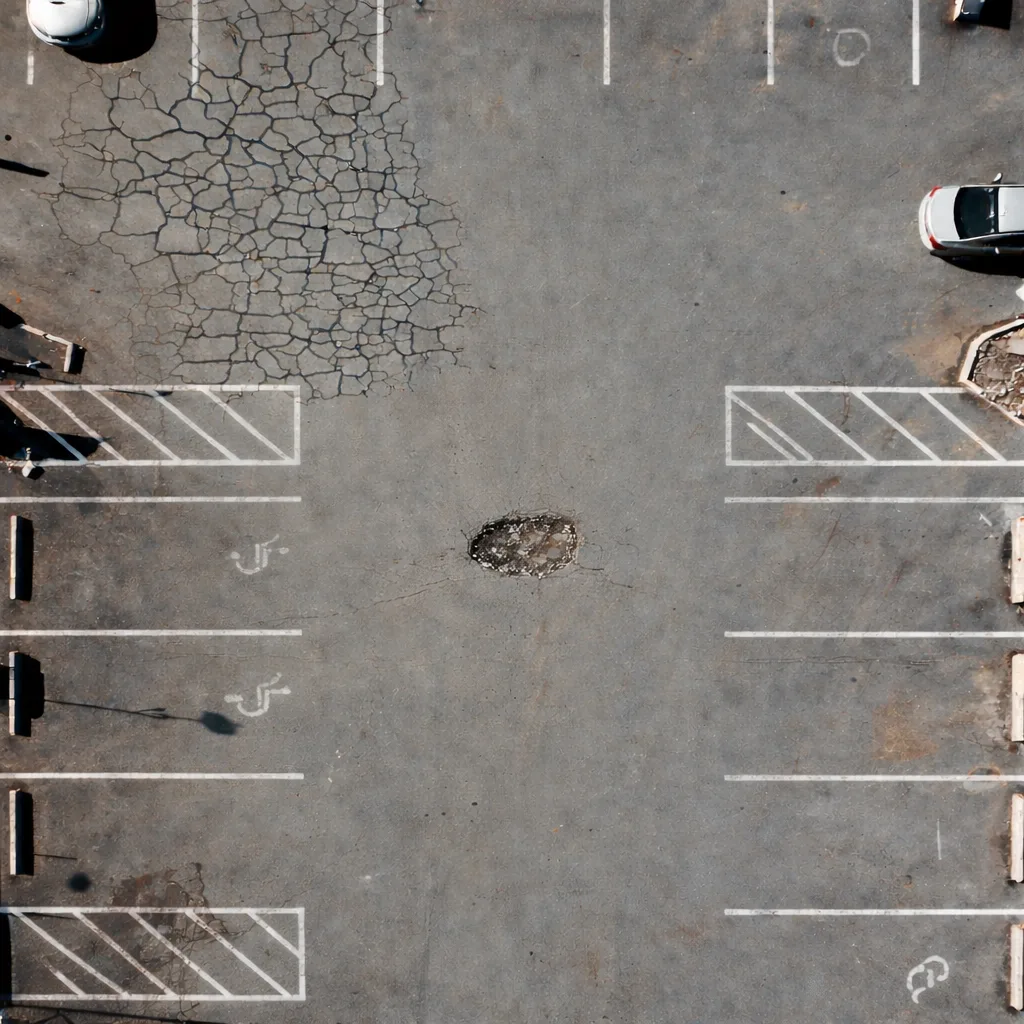
Spot a Problem
Tap an orange hotspot on the photo to learn what's going wrong — and how we fix it.
From Proof-Roll to Final Stripe: How a Commercial Paving Job Runs
What happens after you call your Kansas City paving contractor — from first inspection to final walkthrough.
We inspect your lot, identify every issue, and provide a detailed estimate — no cost, no pressure.
We design the scope of work around your business hours so your operations aren't disrupted.
Old asphalt is milled down, debris cleared, and the base is prepared for a clean bond.
Fresh hot-mix asphalt is laid to spec and rolled to precise compaction with commercial-grade equipment.
Parking spaces, fire lanes, ADA markings, and signage — your lot is fully compliant and looks brand new.
We walk the finished project with you. If anything isn't right, we make it right before we leave.
Industries We Serve Across Kansas City
Different property types have different paving demands. A 600-stall regional shopping center has nothing in common with a 12-bay warehouse loading apron except the asphalt itself. We tailor scope, materials, and scheduling to what each industry actually needs — and we work nights, weekends, and split shifts when the job requires it.
Retail and Shopping Centers
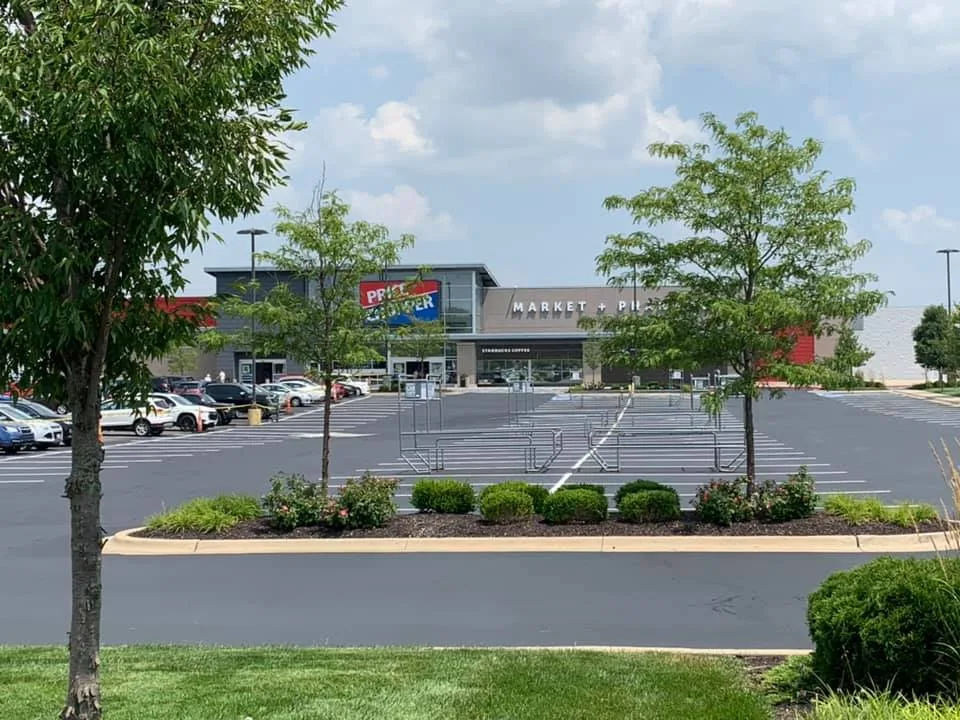
Retail lots take constant traffic, dozens of vehicles per stall per day, and they live or die on curb appeal — a worn-out lot drives customers away before they reach the door. We handle big-box pads, strip centers, outparcels, and grocery anchors. Every retail project gets ADA compliance baked in, fire lane striping reviewed against current code, and scheduling that minimizes business disruption (overnight pours and weekend stripe work when needed).
Apartment Complexes, Condos and HOAs
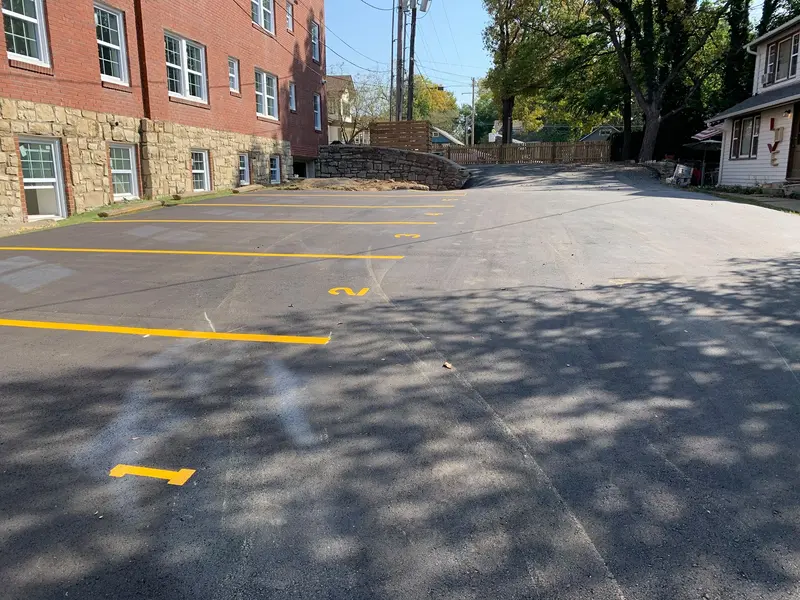
Multi-family and HOA properties have a unique constraint: residents have to come and go while you're working. We sequence apartment community paving in phases — half the lot one day, half the next — so nobody is locked out of their home. We coordinate notice with property management, schedule around trash pickup, and handle the long-term relationships HOA boards need. Most of our HOA work is overlay and crack-sealing maintenance contracts on a 3–5 year cycle.
Industrial and Warehouse Properties
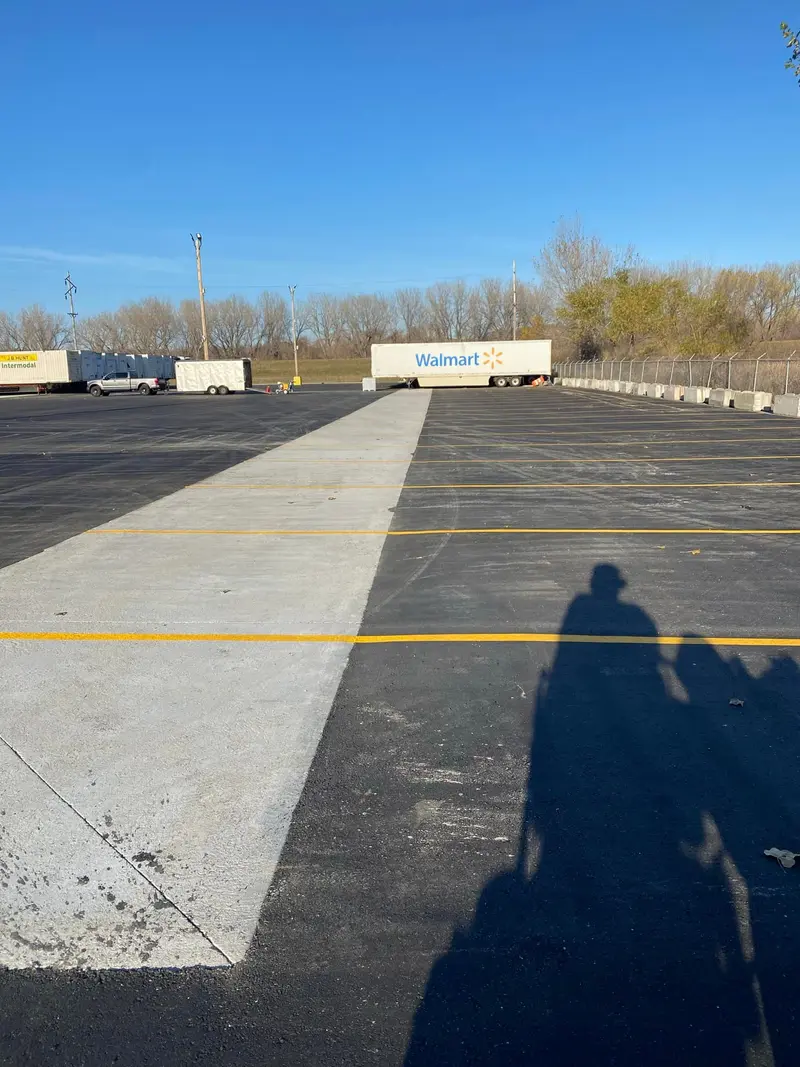
Distribution centers, trucking yards, and warehouse aprons need real engineering. Loaded tractors put 80,000 pounds across five axles every time they hit the dock approach. We design those areas with thicker mats (4–6 inches of asphalt over a heavier base) or full concrete pads at the dock face where wheel loads are static. Truck turning radii get measured before we lay out the lot — paint a 53-foot trailer into a corner that can't take it and you'll be repaving in two years.
Restaurants, Drive-Throughs and Hospitality
Drive-through lanes, hotel front-drives, and restaurant parking all share one thing: they're high-visibility, customer-facing surfaces that get judged the moment somebody pulls in. We coordinate work with grease-trap pump-outs, lighting contractors, and signage installers so the lot reopens fully functional. Drive-through queueing lanes get heavy-duty mat thickness — the constant idle-and-creep traffic chews through standard asphalt fast.
Churches, Schools and Universities
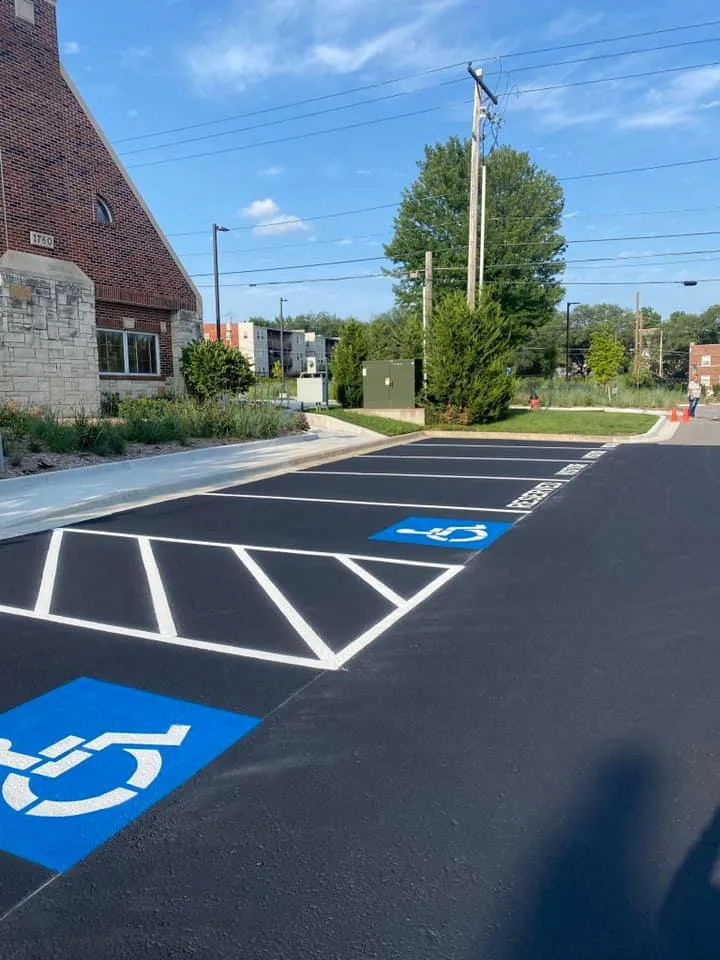
Churches and schools have built-in scheduling: paving has to happen between services, between school years, or over spring break. ADA compliance is non-negotiable on every educational and religious property — accessible routes from parking to the main entry, accessible spaces close to the door, and code-compliant signage. We've worked on K-12 campuses, college athletic facility lots, and church parking expansions where the entire job had to wrap before Sunday morning.
Municipal, Government and General Contractors
We bid municipal work, work as a paving sub for general contractors on commercial new-construction, and handle prevailing wage / Davis-Bacon compliance when the project requires it. GC work means showing up clean, hitting submittal deadlines, providing material certifications, and coordinating with the rest of the trades. We're the paving contractor your GC actually wants on the project — we don't fight the schedule and we don't leave a mess.
Real Work Across the KC Metro
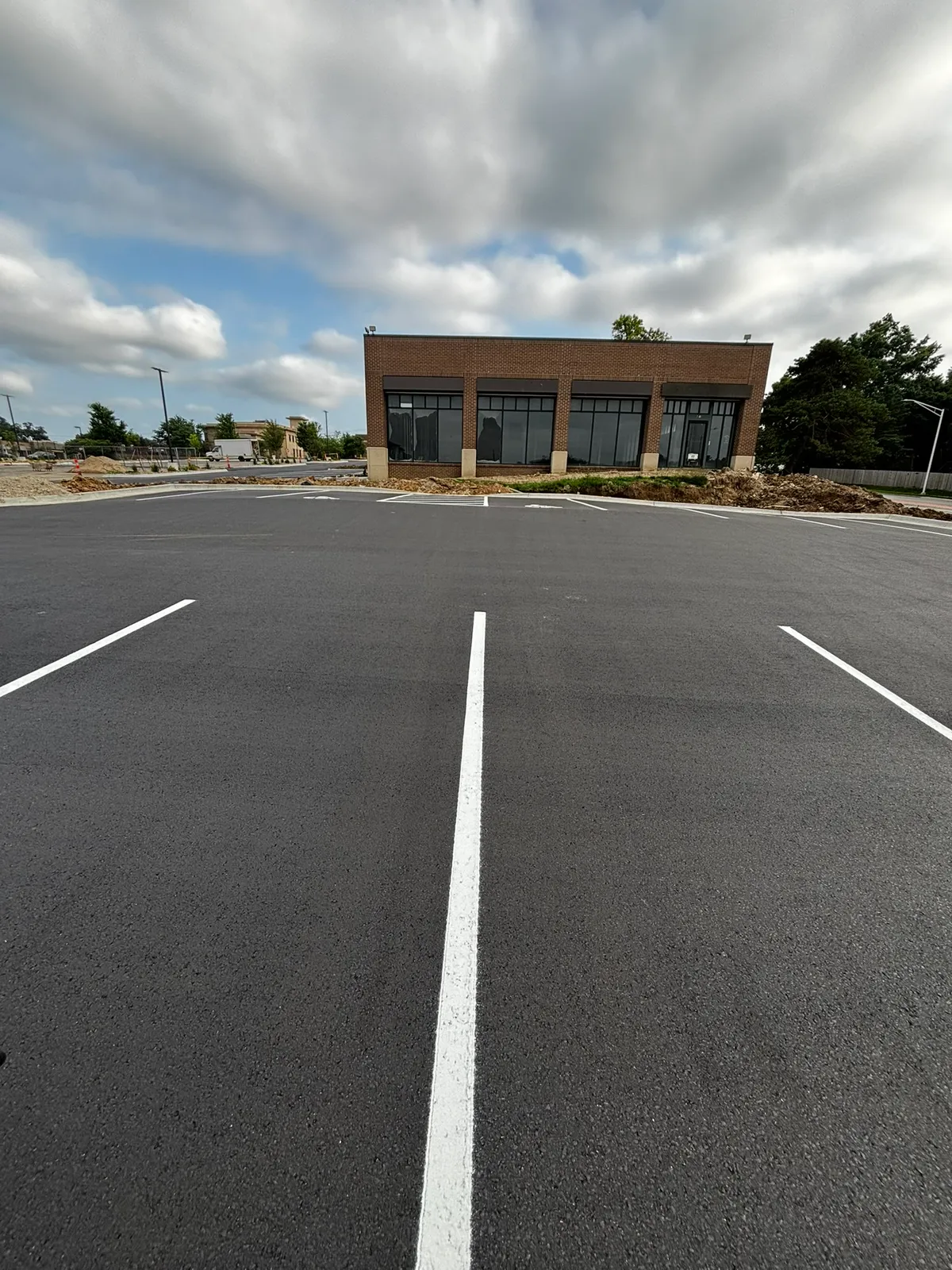
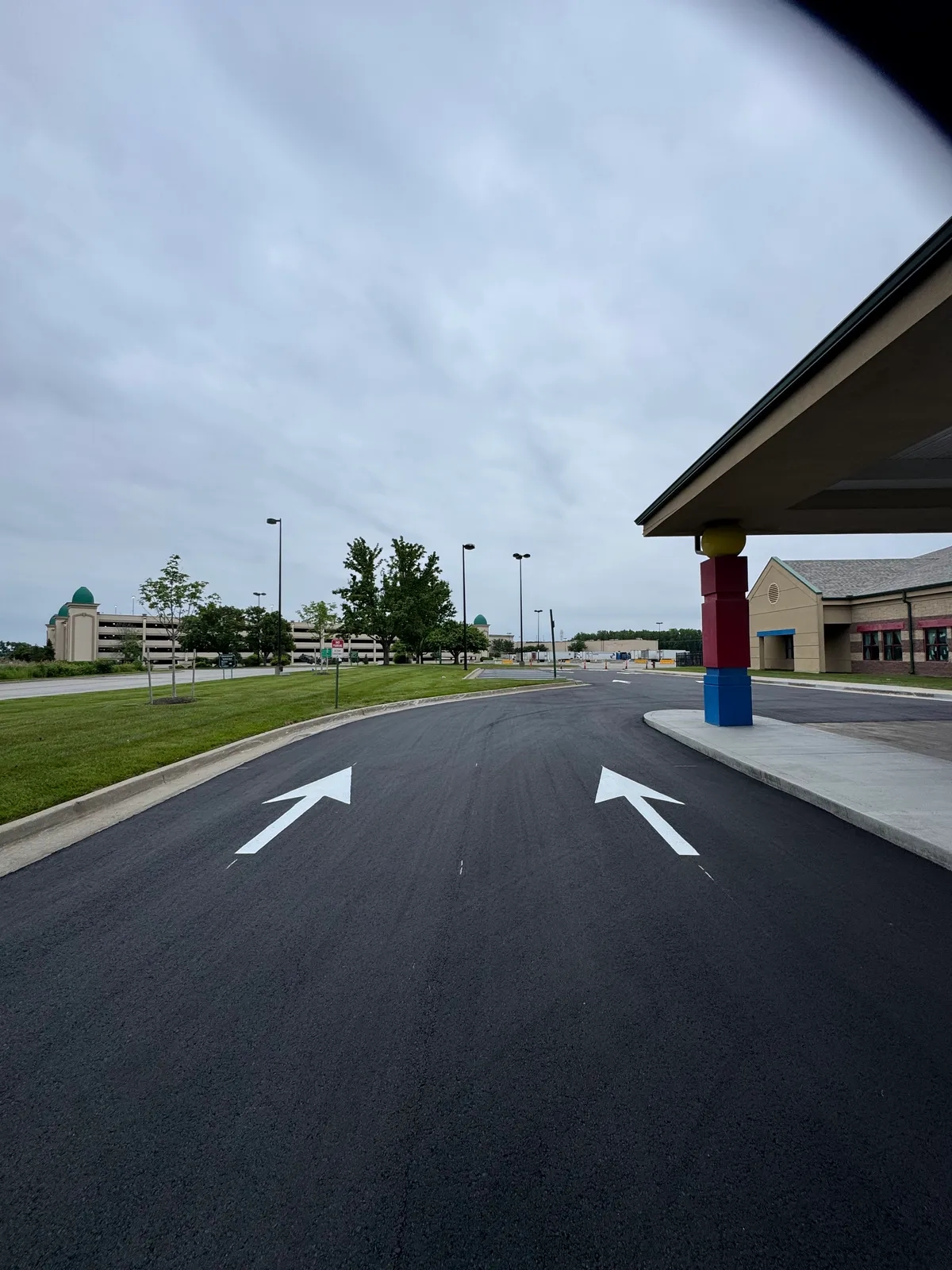
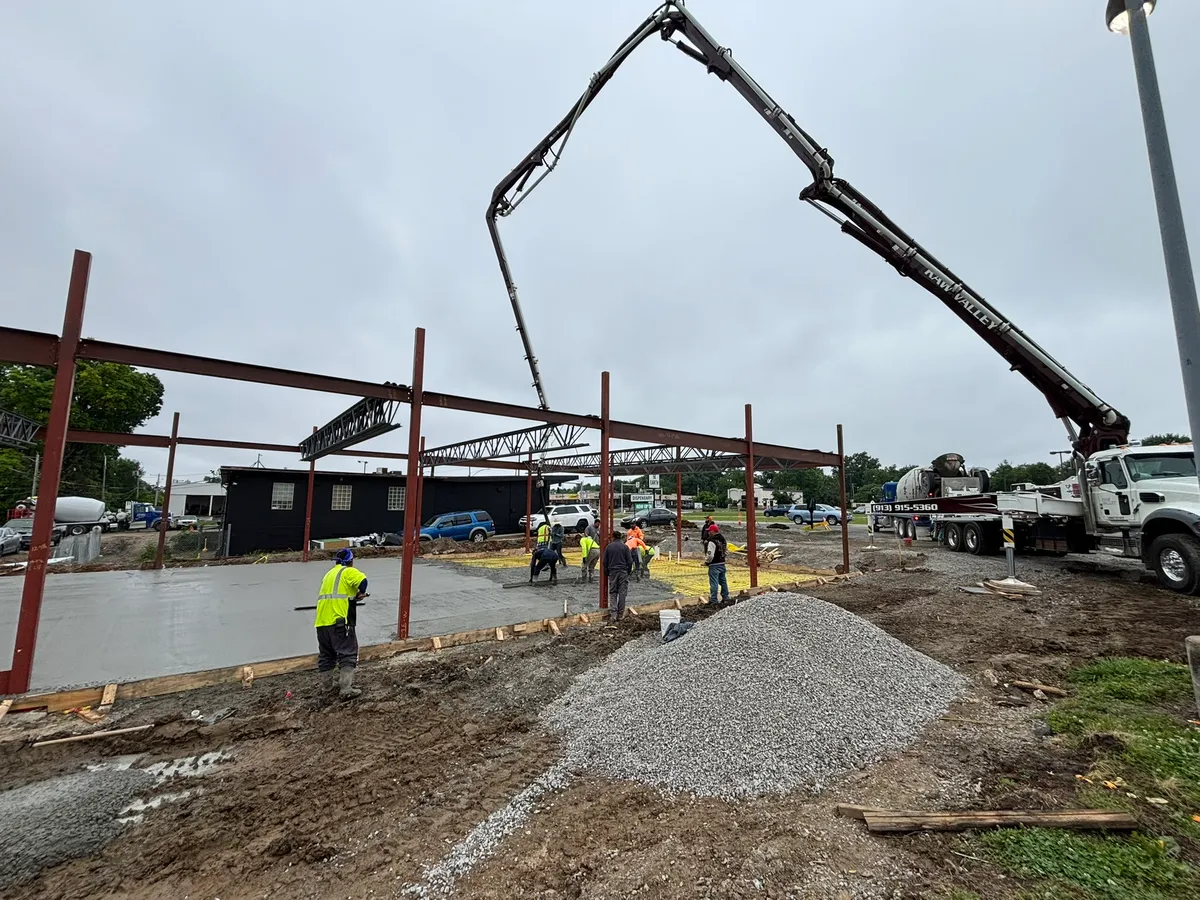
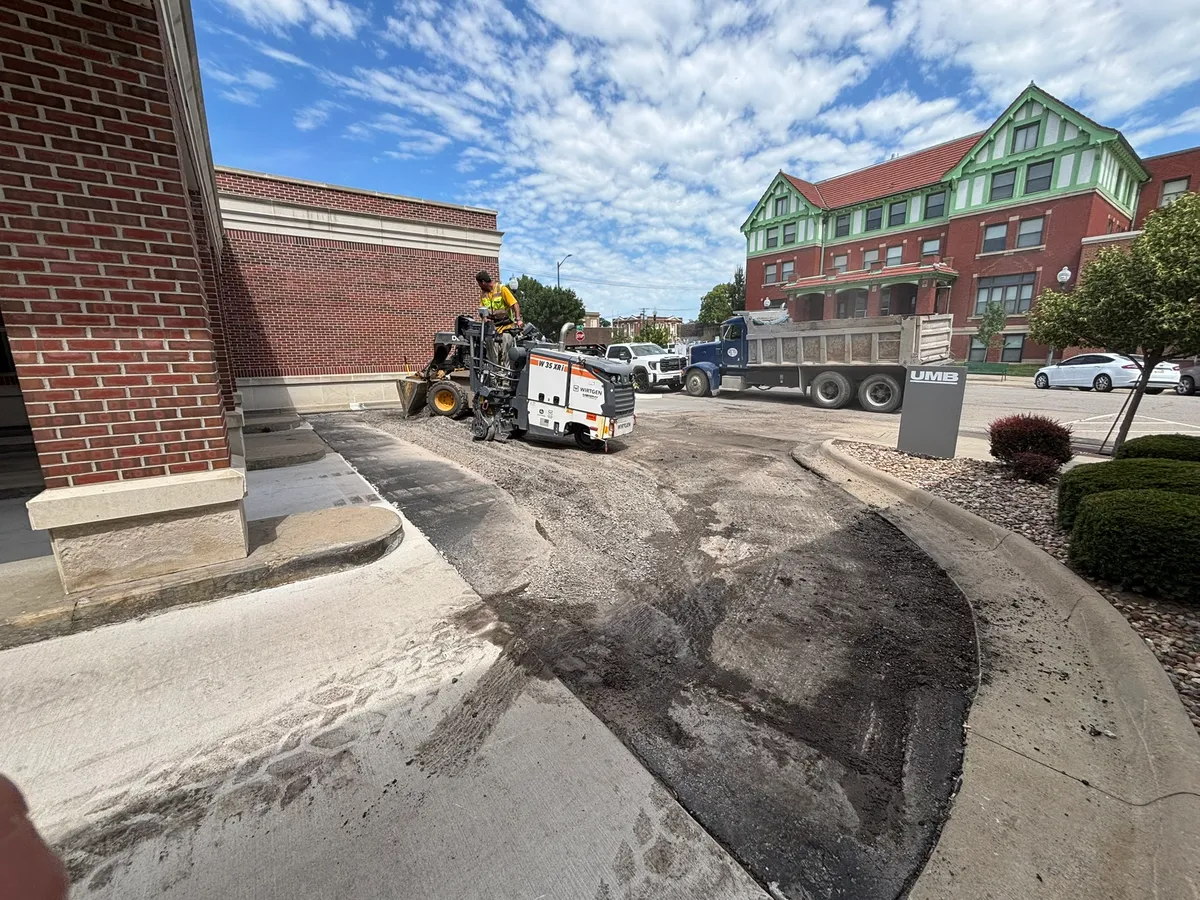
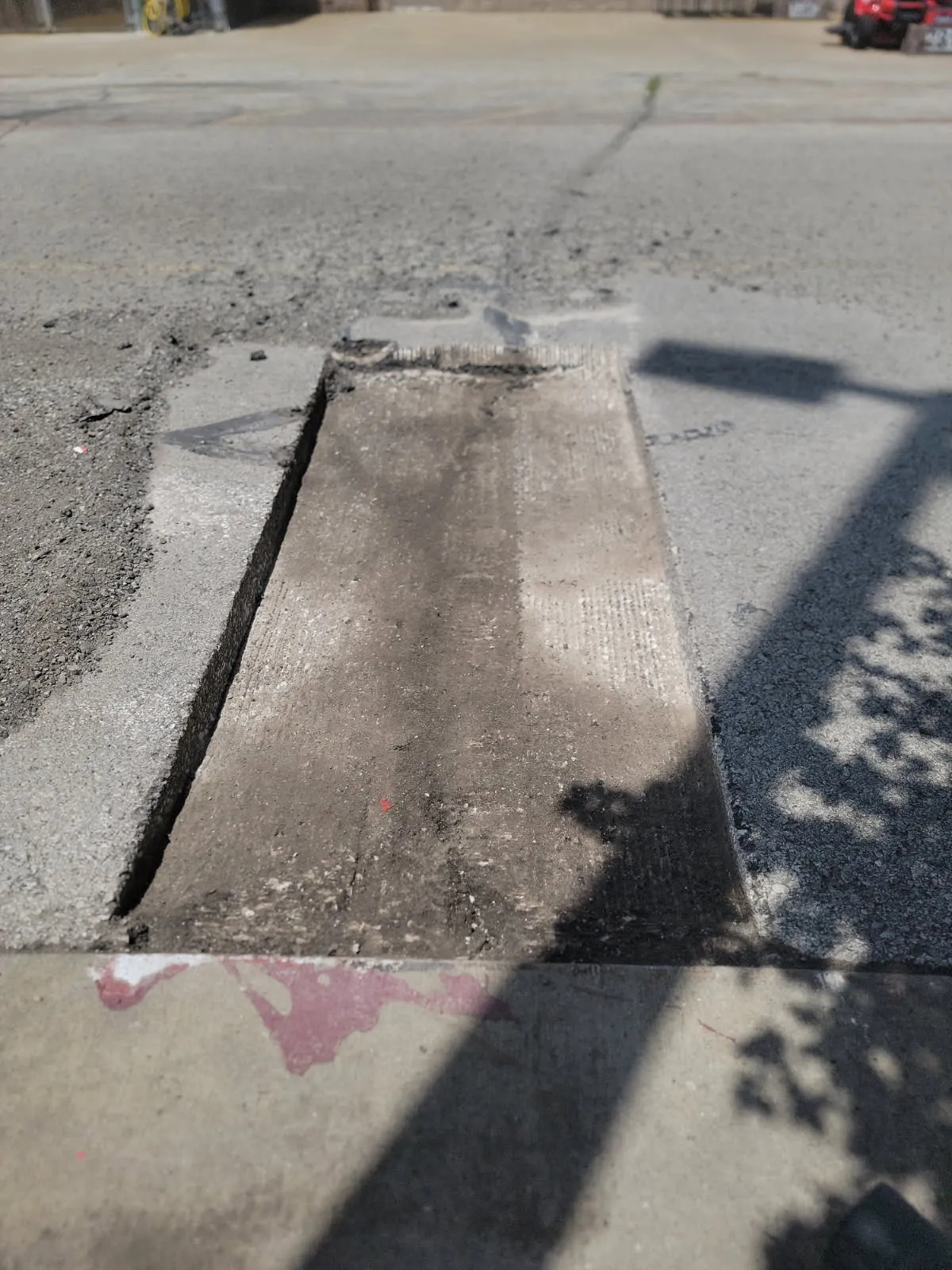
Asphalt Paving Services Across the Kansas City Metro
Platinum Paving works across the entire KC metro — from the industrial corridors of Kansas City, Kansas to the urban core of Kansas City, Missouri. Our paving crew operates out of 832 Cheyenne Ave, Kansas City, KS 66105 and covers every commercial district on both sides of the state line. Kansas City is our home base, so we handle it straight from here — no separate city page to dig for. Pick the service you need on the Missouri or Kansas side below.
Asphalt Paving in Kansas City, Missouri
520,000 residents • Jackson CountySevere concrete spalling in historic districts; asphalt 'shoving' at high-traffic intersections; major utility-related surface cuts in the Crossroads/Downtown.
Asphalt Paving in Kansas City, Kansas
156,977 residents • Wyandotte CountyDeep structural rutting in heavy-truck lanes; subgrade failure in river-bottom lots; concrete joint scaling on industrial scale pads.
We also serve Overland Park, Olathe, Lenexa, Shawnee, Independence, Lee's Summit, and 63 communities across the KC metro.
Kansas City Climate and Soil Challenges
Asphalt that performs in San Diego will fail in Kansas City. The metro sits in one of the most hostile climates in the country for pavement: 50–60 freeze-thaw cycles per year, summer surface temperatures over 140°F on a black asphalt lot, and a clay-heavy subgrade across most of Jackson and Cass counties that swells when it gets wet and shrinks when it dries. Every freeze-thaw cycle is another chance for water in a hairline crack to expand, push the surrounding asphalt outward, and turn a 1/8-inch crack into a 6-inch pothole.
Soil matters even more than weather. Most of Jackson, Cass, and southern Wyandotte counties sit on expansive clays that demand heavier base preparation — usually 8 inches of compacted crushed limestone, sometimes with a geotextile separator, to keep the clay from pumping moisture into the base. Johnson County's sandy loam drains better but still needs proper compaction. Drainage is the single biggest factor in pavement lifespan in this metro: a properly graded lot lasts 20+ years, a poorly graded one starts failing within five.
The asphalt paving season in Kansas City runs from late March through early November. Hot-mix asphalt requires ground temperatures above 50°F for proper bonding and compaction. Below that, the mat cools too fast for the rollers to achieve density and the surface ravels within months. We don't pave in marginal weather — and we'll tell a customer that pushing a November pour into December is a worse outcome than waiting until April.
The Equipment and Materials We Actually Use
Our paving fleet includes track and rubber-tire pavers for both commercial parking lots and tighter residential driveways, double-drum vibratory steel rollers and pneumatic-tire (rubber) rollers for the finish pass, skid-steer loaders with milling and broom attachments for tight spots, and dump trucks for material delivery. Mix arrives from local KC-area HMA plants at 275–300°F so it lays down hot enough to compact properly before it cools.
On materials: we run standard surface mix and binder mix for parking lots and access roads, and step up to polymer-modified mixes for high-stress areas like dock approaches and intersection pads. Sealcoat is commercial-grade coal tar or asphalt emulsion from established suppliers — not the diluted retail stuff. Crack sealant is hot-pour rubberized polymer applied at spec temperature. Compaction is verified with a nuclear density gauge on commercial pours, not eyeballed.
What Affects the Cost of Asphalt Paving in Kansas City
We don't publish square-foot pricing on the website because every commercial paving project is different and a number without context is worse than no number at all. What we can tell you is exactly what drives the price up or down on any given job, so you can compare bids from other asphalt companies and paving companies in Kansas City and know what you're actually looking at.
- Square footage and geometry. Bigger lots get cheaper per square foot. Long, simple rectangles are cheaper than tight lots full of curbs, islands, and ADA detail.
- Existing base condition. A lot with a sound base that just needs an overlay costs a fraction of a lot that needs full-depth reclamation.
- Mix specification. Standard hot-mix is the baseline; polymer-modified asphalt for heavy-load zones costs more per ton.
- Site access. If a paver and dump truck can pull straight onto the lot, labor is fast. If material has to be wheelbarrowed or hand-screeded around obstacles, it isn't.
- Time of year. Late-season work (October–November) gets squeezed against the weather window, which tightens scheduling and sometimes cost.
- Striping, signage and ADA work. A new lot needs full layout and stripe; a re-striped lot needs less. ADA upgrades add line items.
- Traffic control and phasing. Open-business work that has to be sequenced around customer traffic is more expensive than a closed-down full-lot pour.
We give every customer a free on-site assessment, a written scope, and a fixed price before any work starts. No change-order surprises, no "we hit something unexpected" calls a week in.
Commercial Paving Is Not Residential Paving
Platinum Paving is a commercial asphalt and concrete contractor first — that's most of what we do, and the work we're built for. Commercial paving and residential paving aren't just different sizes of the same job. They're engineered, scheduled, warrantied, and inspected differently. A residential driveway crew using residential mix specs on a 200,000-square-foot retail lot will produce a lot that's failing in a year.
- Engineered drainage. Commercial lots are graded to specific positive-slope minimums and tied into stormwater inlets. Residential is rarely engineered.
- Heavier base and thickness. Commercial standards specify a thicker compacted base and 2–3 inch (or thicker) asphalt mat versus 1.5–2 inches typical for a driveway.
- ADA compliance. Required on commercial. Not on residential.
- Traffic control during construction. Commercial jobs need flagging, phasing, and customer-traffic management. Residential doesn't.
- Code compliance and inspections. Most commercial projects involve permit submittals, drawing reviews, and inspection sign-offs. Residential almost never.
We do take large residential driveway work — particularly long rural driveways where the spec is closer to a commercial access road than a typical homeowner driveway. For those projects we apply commercial paving standards, which is why they outlast the average residential pour.
Why One Asphalt Paving Contractor Beats Five Subcontractors
Most property managers juggle separate contractors for asphalt paving, concrete, sealcoating, striping, and ADA compliance. That means five phone calls, five schedules, five invoices, and five chances for something to fall through the cracks.
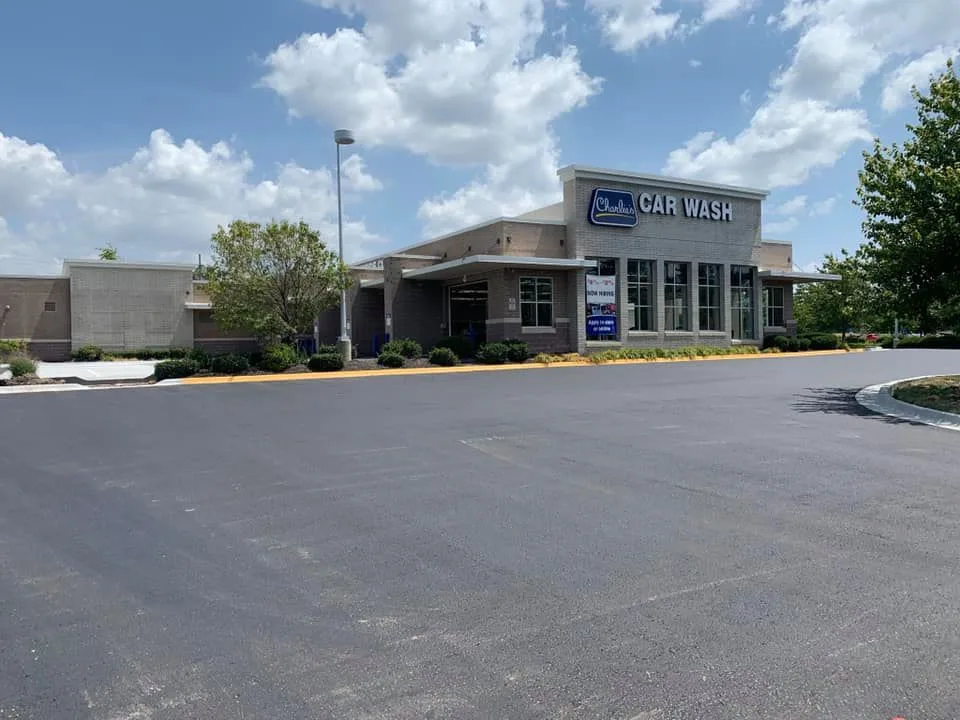
Platinum Paving handles all of it — from new asphalt paving and construction to pavement maintenance, sealcoating services, and ADA ramp compliance. One paving company, one point of contact, one crew that stands behind every square foot.
Single-Source Paving Contractor
No finger-pointing between vendors. One asphalt company responsible for every square foot of your lot.
Coordinated Paving and Construction
Milling, asphalt paving, and striping done in sequence, not weeks apart. Less disruption to your business.
1-Year Warranty on All Paving Services
All workmanship and materials backed by a 1-year warranty — every asphalt and concrete service, every project.
Kansas City Metro Paving Coverage
Serving the entire KC metro from one dedicated asphalt paving team. We know your area and we show up on time.
Kansas City's Asphalt Paving Results by the Numbers
Built on Accountability, Backed by Asphalt Paving Results
Our owner personally inspects every asphalt paving project and stands behind the work. When a job doesn't meet his standard, he comes out himself, makes it right, and doesn't stop until you're satisfied — even if it means redoing the work at his own expense.
That commitment to doing the right thing is why we've completed over 4,000 paving projects across Kansas City and earned a 5-star Google rating with 86+ reviews. Our customers don't just hire us once — they call us back year after year for pavement maintenance and new construction.
"Honesty, Quality, and Affordability — that's not a slogan, that's how we run every job."
Recent Projects From the Field
A look at commercial paving and concrete work recently completed by the Platinum Paving crew across Kansas City and the surrounding region.
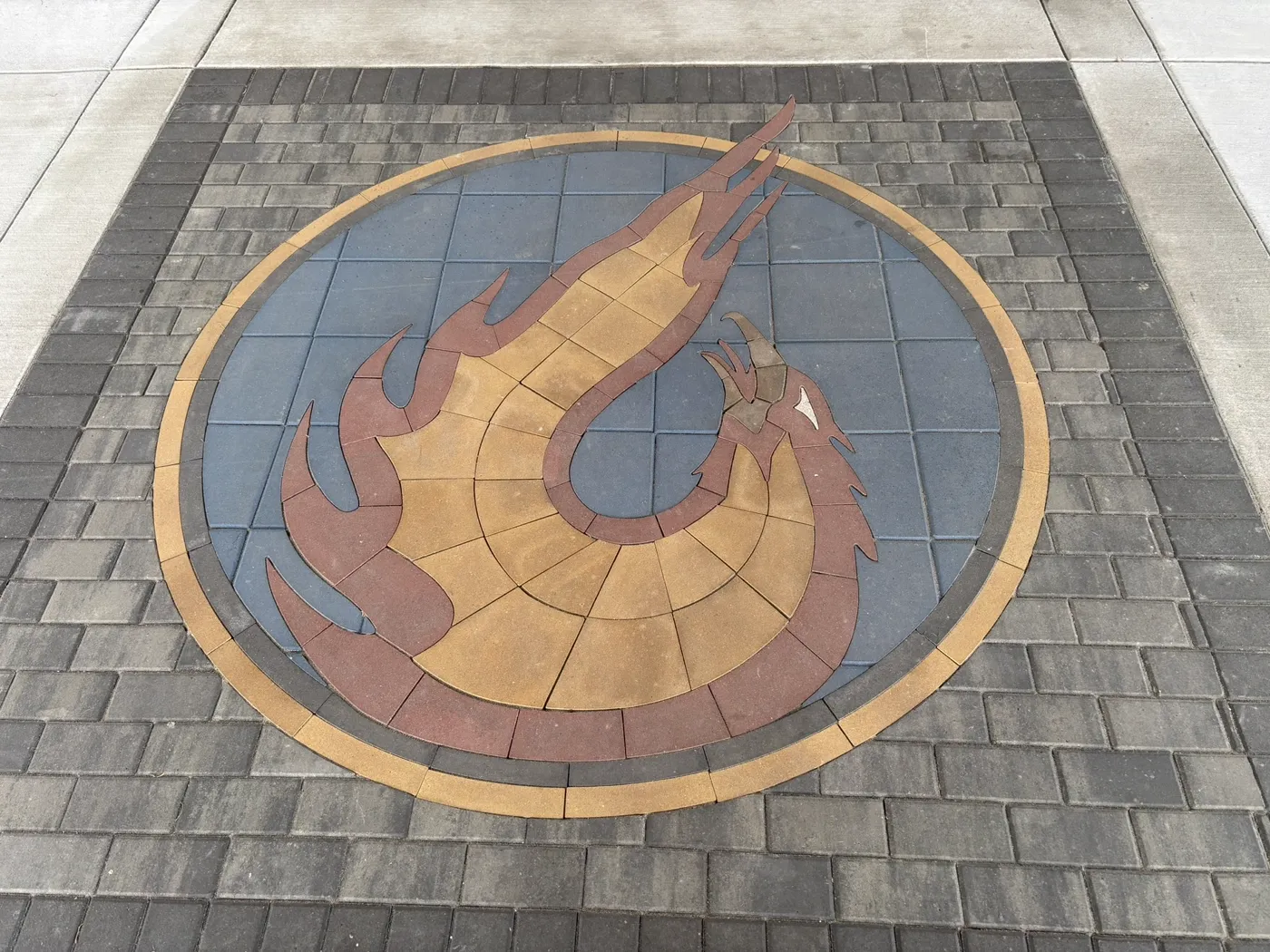
Removal and replacement of custom branded entrance pavers at Prairie Band Casino & Resort.
View Project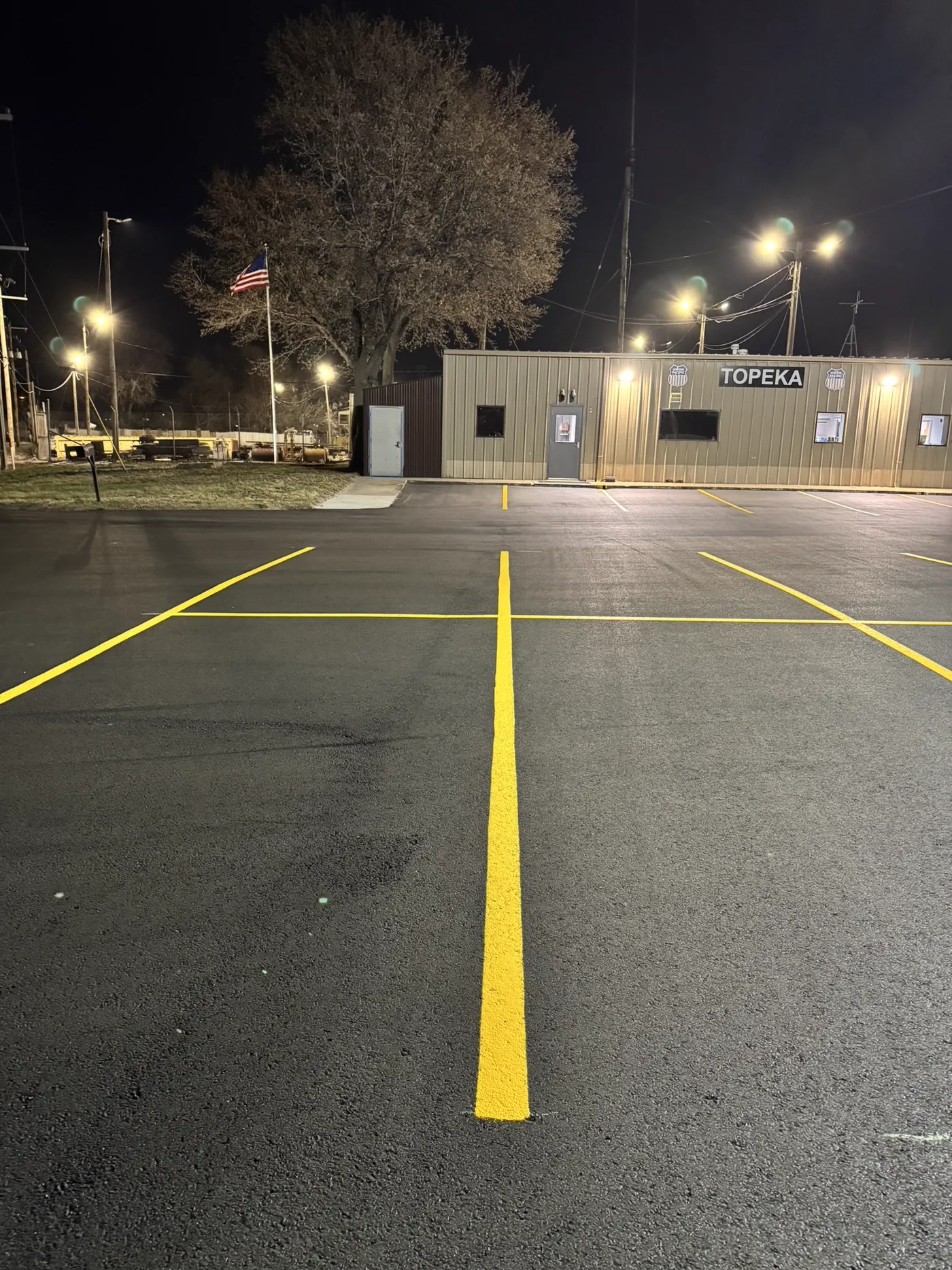
Milled off a failing surface and laid a fresh hot-mix overlay to restore the railroad's employee parking lot.
View ProjectAsphalt Paving Resources and Guides
Expert insights on commercial asphalt paving, parking lot maintenance, and pavement construction from our Kansas City paving team.
Comparing cost, durability, maintenance, and climate performance for commercial properties.
Read More The ideal sealcoating schedule for Kansas City properties and the signs it's time to recoat.
Read More ADA requirements for KC parking lots — accessible spaces, ramps, signage, and avoiding violations.
Read MoreFrequently Asked Questions About Asphalt Paving in Kansas City
What affects the cost of asphalt paving in Kansas City?
Cost depends on square footage, the condition of the existing base, mix specification (standard hot-mix versus polymer-modified), site access for paving equipment, time of year, and the amount of striping, signage, and ADA work the project requires. Every commercial project is different, so we give every customer a free on-site assessment and a fixed written price before work starts. Call (913) 701-6044 to schedule yours.
How long does a commercial asphalt paving project take?
A simple parking lot resurface (mill and overlay) on a 30,000 square-foot retail lot can be done in 2–3 days. A full-depth reconstruction of the same lot takes 5–10 days because of demolition, base prep, and curing time. Large industrial projects and phased apartment-complex work can run 2–4 weeks. We always schedule around your business and tell you up front exactly when the lot reopens.
Can you pave during winter in Kansas City?
Hot-mix asphalt requires ground temperatures above 50°F for proper compaction and bonding, so the Kansas City paving season runs from late March through early November. Below that range, the mat cools too quickly for the rollers to achieve density and the surface ravels. During the off-season (December through February) we book and plan spring projects so the work is ready to launch the day temperatures recover.
Is asphalt or concrete better for a commercial parking lot?
Asphalt is the right choice for the vast majority of commercial parking lots: it costs less to install, can be opened to traffic faster, and is easier and cheaper to maintain. Concrete is the better choice for high-static-load areas — dock approaches, dumpster pads, drive-through lanes, and intersection pads where loaded trucks idle. Many of our projects use both: asphalt for the parking field, concrete for the heavy-load zones. We help customers pick the right material for each part of the lot.
How often should I sealcoat a commercial parking lot in Kansas City?
For most commercial properties in the KC metro, sealcoating every 2–3 years is the right cycle. High-traffic retail, convenience stores, and gas stations may need recoating every 18–24 months because of heavier wear and fuel exposure. Sealcoat is preventive maintenance, not a repair tool — it slows oxidation and water penetration, but it won't hide cracks or fix base failure. The right time to sealcoat is when the existing coat is starting to fade but the surface is still sound.
What asphalt paving services does Platinum Paving offer?
We are a full-service asphalt paving contractor in Kansas City offering new asphalt paving, asphalt overlays and resurfacing, milling, asphalt repair and patching, crack sealing, pothole repair, commercial sealcoating, and line striping and pavement marking. We also pour new concrete, repair existing concrete, install curbs and gutters, and bring lots into ADA compliance — making us a true one-stop paving company for every parking lot need.
What areas in Kansas City does your paving company serve?
Platinum Paving serves the entire Kansas City metro on both sides of the state line — Wyandotte, Johnson, Jackson, Cass, Clay, Platte and Leavenworth counties. Our asphalt paving services cover Kansas City MO, Kansas City KS, Overland Park, Olathe, Lenexa, Shawnee, Independence, Lee's Summit, Blue Springs, Liberty, and 50+ additional communities. We operate from 832 Cheyenne Ave, Kansas City, KS 66105.
Do you offer warranties on your paving work?
Yes — every project from Platinum Paving comes with a 1-year warranty on workmanship and materials. If something doesn't hold up, we come back and make it right. Our owner personally inspects every job and stands behind the work — that's not a marketing line, it's the reason we've completed 4,000+ projects across the Kansas City metro and earned 5-star reviews from property managers who call us back year after year.
Kansas City's Best Asphalt Paving Contractor — One Call Away
Whether you need new asphalt paving, resurfacing, asphalt repairs, or pavement maintenance — our paving company handles it all. Get a free estimate from the Kansas City paving contractor that's completed 4,000+ projects across the metro.